Showing posts with label Portland. Show all posts

Tuesday, August 18, 2020

TO SIGN OR NOT TO SIGN


A US Census lady knocked on my door over the weekend and asked very few questions compared to what were asked during the 2010 or 2000 census. After recording names, sexes, and birthdates of people who lived at my address on April 1st, she came to the inevitable race question which went something like: did I consider myself Hispanic? I told her I’m human; so is my wife, and that’s all she needed to know. With that she said she was all done and got up to leave.


Surprised, I asked her what the federal government would do with data about race if I had identified myself as belonging to one of its categories. She said would have had more questions if I had identified as “white.” She would have asked about ethnicities like Irish or Italian, but since I declined to racially categorize myself or my wife, she stopped. There were no questions about religion, occupation, or citizenship status — the kind of data useful to historians studying trends. Perhaps she knew I was a retired teacher, but wasn’t aware that I still work. We live in the same town and I know her and her family.


Government at all levels is obsessed with discriminating between people based on skin color or ethnicity, and has been for as long as I can remember. Decades ago I stopped cooperating. When encountering ubiquitous race questions on official forms, my habit is to draw in a box, label it “human” and put a check it. While distributing state testing forms in my public school classroom, I suggested to students that they could do the same. Many did.


Obsession with race is getting worse. At the University of Southern Maine in Portland — a state institution — president Glenn Cummings recently asked all students and faculty to sign a “Black Lives Matter Statement and Antiracism Pledge.” He intends to publish a list of everyone who signs it, and that, by process of elimination, would also become a list of those who did not sign it. Would they then be subject to sanctions or harassment?


What about students and faculty who, while recognizing historical oppression of blacks in America, disagree with BLM’s anti-capitalism or its inherent Marxism? How about those who object to a pledge by BLM’s Greater New York president Hawk Newsome that: “If this country doesn't give us what we want, then we will burn down this system and replace it”? Or how about those who disagree with Chicago BLM organizer Ariel Atkins who said BLM rioters looting stores were justified because: “That is reparations. Anything they wanted to take, they can take it because these businesses have insurance.”


The University of Southern Maine pledge states that:


We stand in solidarity with those who are working for justice and change. And we invite you to join us in pledging to be a practicing antiracist at the University of Southern Maine and in all aspects of your life. We believe, as Ibram Kendi writes, that "the only way to undo racism is to constantly identify it and describe it — and then dismantle it.”


Never having heard of Ibram Kendi, I did searches on him. His latest book is: How To Be An Antiracist. About it, Christopher Caldwell contends in National Review:


Anti-racists assume that the American system of politics, economics, and policing has been corrupted by racial prejudice, that such prejudice explains the entire difference in socioeconomic status between blacks and others, that the status quo must be fought and beaten, and that anyone not actively engaged in this system-changing work is a collaborator with racism, and therefore himself a legitimate target for attack.


This is dangerous rhetoric. It assumes that “systemic racism” is a real thing — that if you’re white, you were born with “white privilege,” as well as inherent racism against so-called “people of color.” If you don’t sign pledges like the one USM President Glenn Cummings urges you to sign, if you don’t kneel during the national anthem, if you don’t constantly proclaim that you’re not racist, you might as well proclaim that you are. The USM “community” will no doubt see you as such.


USM is a state institution. It’s supported by our tax dollars and it shouldn’t be pressuring its students or faculty to support political positions, much less radical-left ideologies like those espoused by Black Lives Matter. Along with almost all levels of government, USM is obsessed by race. We would all do better to insist there is only one race — the human race — and no subsidiaries exist.


Tuesday, August 20, 2019

Portland Maine Students Vote With Their Feet


Deering High School
School choice is a good thing, and it is highlighting problems in Portland, Maine. The city has two large high schools and students can attend whichever one they choose. The Portland Press Herald ran a series of articles over the summer indicating why so many students and their parents are choosing Portland High School over rival Deering High School. Most cited student discipline, or lack thereof.

Meg Baltes (Portland Press Herald photo)
They like Portland High School because, as Meg Baltes — president of the rising junior class at Portland High School — put it to Press Herald reporter Rachel Ohm: "I think things are handled very swiftly and very aggressively at Portland. Any kids who get into trouble are dealt with pretty immediately. It’s a very no-nonsense policy. I know students see that and that helps a lot with problems being diverted.”
Students at Deering (from Press Herald)
It’s a different story at Deering. As former math teacher Tim Eisenhart put it in the same article, “There’s a weird lack of discipline inside the building. [The administration] is too soft and what ends up happening is kids do whatever they want.” Eisenhart resigned mid-year and went back to his engineering career. “I think you will find there’s a lot of shoveling it under the carpet, because [administrators] didn’t do anything. They send kids back [to class] less than 15 minutes later with a cupcake without doing anything.”


As a retired teacher with two years teaching delinquent high school students in Lowell, Massachusetts and thirty-three years in Maine public schools, those two quotes sum it up. If teachers aren’t backed up by building administrators when disciplining a students, everything breaks down. If I sent a student to the office (which I rarely did) and a principal sent him back with no consequence, I’d send him out again and inform the principal that he was not allowed in my classroom until an appropriate consequence was enforced, and I would not continue teaching otherwise.

From Portland Press Herald
Projected enrollment for the freshman class in Portland next month is 272, while at Deering, it’s only 127. Nine years ago the numbers were roughly equal with Deering at 245 and Portland at 232. Clearly things have changed at Deering. As Meg Baltes went on to say: “A lot of students at Deering feel the administration is chill and relaxed. They feel they can talk to them and have a more honest relationship, but it also means there’s less discipline and a feeling they can get away with stuff.”

Principal Gregg Palmer in drag (Press Herald photo)
Neither Deering Principal Gregg Palmer nor Assistant Principal Abdullahi Ahmed would answer specific questions from the Press Herald. Principal Palmer did, however, perform in Deering’s Gender Sexuality Alliance 2nd Annual Drag Show dressed as a woman. “This is all about them [the students],” Palmer said. "They are brave and they encourage the rest of us to be brave,” as he told the Press Herald. Too bad that bravery didn’t enable Palmer to back up teachers dealing with his problem students. One parent said to the Press Herald: “I think they’re too scared to discipline students in a way that would have an impact, so they just let things go a lot of the time without even a slap on the wrist.”

Superintendent Xavier Botana (Press Herald photo)
Deering administrators referred all the Press Herald’s discipline questions to Superintendent Xavier Botana who tried explaining it away as a lack of communication regarding violent incidents at Deering last year. Then he indicated that, “[H]e plans to start a conversation with the school board about capping the number of students that can attend each school.” In other words, Superintendent Botana wants to limit school choice. He doesn’t want students voting with their feet because that’s making his job difficult.
School board Chairman Rodrigues
Even if Superintendent Botana were to pressure his administrative team at Deering to toughen up, he may not be backed up by his school board. Board Chairman Roberto Rodriguez told the Press Herald: “It’s difficult to change the expectations of what discipline truly means. If we have an old-school expectation of what discipline is, something like zero-tolerance, then yes, you’re not going to see that today. That’s not how we want to discipline our students.”
Really Mr. Rodriguez? How would you do it? It looks like Deering is in for another tough year.

From Portland Press Herald
Complicating all this are changing demographics. Though it used to enroll the poorest kids in the city a generation ago, Portland High School is located on Portland’s peninsula where real estate values have skyrocketed. The Deering neighborhood used to be more prosperous but has lately absorbed a high concentration of so-called “refugees” and “asylum seekers,” many of whom speak no English. The Press Herald reports: “In 2018-2019, minority students accounted for about 47 percent of the Deering student body. Twenty percent were English language learners and 57 percent were economically disadvantaged, according to school district data.”

Portland from South Portland
Big city problems have arrived in once-placid Portland, Maine.

Tuesday, December 04, 2018

Lighthouses


Bug Light
Not too long ago I promised myself I would avoid photographing lighthouses because everyone does that. Galleries in Portland, Maine’s Old Port district are loaded with paintings and photographs of lighthouses. When cruise ships tie up in Portland Harbor, local artisans set up their tables along Commercial Street selling all sorts of things, but what do you see the most of? Lighthouses. There are ceramic lighthouses, trivets with lighthouses, coffee cups with lighthouses, as well as paintings and photographs of lighthouses. Cruise ship passengers from around the world walk by and scoop them up.

Bug Light
Now, however, I have dozens of lighthouse photos, hundreds maybe. Our South Portland, Maine house is five minutes from two of them and ten minutes from two more. Because I always have a camera with me and all four lighthouses are situated in places I visit often — beautiful public parks or on state-owned land by the sea — I’ve become captivated by the lighthouse mystique. Maybe it’s their simple, functional design. Maybe it’s because they’re safety beacons situated in places of both great natural beauty and also great danger. Whatever it is, I’ll likely be taking hundreds more images of them before I’m dead.

Bug Light
The Portland Breakwater Lighthouse, otherwise known as “Bug Light,” is five minutes away. Every morning before breakfast I jog past the lighthouse in Bug Light Park and my camera is always in my car parked two hundred feet from it. Sometimes the rising sun shines so beautifully upon it that I cannot resist snapping a picture, or two, or three. I can put the Portland skyline in the background or use the islands in Casco Bay as backdrops, including the solid-granite, Civil-War-era Fort Gorges that still sits across the shipping lane a few hundred yards offshore.

Spring Point Light
My wife and I will often go for a stroll around Bug Light Park after dinner in spring, summer, and fall. As all photographers know, the best shooting light is just after sunrise or just before sunset — at which time we sometimes see stunning cloud formations behind Bug Light. The sun sets over the City of Portland across the harbor and I’ve taken dozens of shots with the Portland skyline in the background. The late film director Jonathan Demme called it “the golden hour."

Portland Head Light
Bug Light is unique among lighthouses in that its design was inspired by the Choragic Monument of Lysicrates which was built next to the Athenian Acropolis in 335 BC. It’s a classic design often copied around the world, especially during America’s Greek Revival period in the mid-19th century when the lighthouse was built. It’s the smallest of all Maine lighthouses, and classically beautiful.

Portland Head Light
Within sight of Bug Light, and also a five-minute drive away, is Spring Point Ledge Light on the SMCC campus (Southern Maine Community College). I often go there first to watch the sunrise. From Spring Point Light one can see both Bug Light and Portland Head Light at Fort Williams in Cape Elizabeth. On mornings with particularly good light, I’ll visit all three before going home for breakfast. At that early hour, I have them all to myself.

Portland Head Light
Portland Head Light was commissioned by the US Government and completed in 1791 while George Washington was president, and after the federal government took over control of all US lighthouses. The United States at that time stretched only from Maine (part of Massachusetts then) to Georgia and almost the entire population lived between the Appalachians and the Atlantic.

Ram Island Light
From Portland Head Light one can see Ram Island Ledge Light across the shipping channel. It was completed in 1905 after several shipwrecks on that dangerous ledge, but then all lighthouses were constructed following maritime mishaps. Also visible from Portland Head Light are two more lighthouses to the south at a location appropriately called “Two Lights” in Cape Elizabeth. Those were first built in 1828. While I’ve taken no pictures of “Two Lights,” I have many of the rocky shore at the nearby “Two Lights State Park” which I try to visit every week.

Spring Point Light
Portland Head Light is perhaps the most photographed lighthouse in America according to Smithsonian Magazine. According to oyster.com, it’s one of the top ten most iconic lighthouses in the entire world. That means that my photos have lots of competition, but I have the advantage of close proximity during every season of the year. Being semi-retired, I also have the time.
Portland Head Light
Four lighthouse pictures hang in our South Portland house and two hang in Lovell, so far. There may be more. One winter lighthouse shot hangs in a local hospital and I wouldn’t be surprised if they should pick a few more when their budget allows.

Tuesday, November 06, 2018

Going To The County Jail


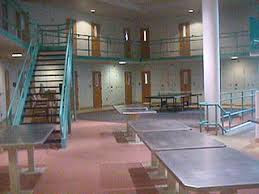
After the last remote-control lock on the last steel door opens with a loud, metallic clang, I walk into B-1, the two-tiered, oval-shaped “pod”  at the Cumberland Country Jail in which I’ve been running a weekly Bible study for two-and-a-half years. The eighty-five inmates there are dressed in orange or blue. Some are in their teens. Some look to be in their sixties or seventies, but it’s hard to guess ages of men who live hard lives. Smoking, drinking, fighting, poor nutrition, repeated physical and/or emotional traumas age them prematurely.

All the pods look like this
Some stand in pairs talking. Some are stripped to the waist doing chin-ups on cross bars. Some are seated at steel tables bolted to the concrete floor and playing cards. Some are just standing around looking scary with neck and face tattoos around primal, calculating eyes. One, sometimes two correctional officers (COs in jail parlance) are on duty. He or she sits at a desk in the middle of the oval with electronic controls to all cells and rooms on both tiers. I wait a minute for the CO to recognize me and remotely unlock the door to my classroom on the lower tier.


Inmates are screened upon arrival at the jail before being assigned to various pods depending on whether they’re detoxing, suicidal, aggressive, or determined to be cooperative at some level. Inmates in B-1 have usually been sentenced to less than a year, but some are awaiting trial with potentially long prison sentences if found guilty. After further evaluation on the pod, some are chosen to work, usually in the kitchen where they earn “good time” — which is time off their sentences. Those inmates are called trustees and given blue jumpsuits, but they can “lose the blues” for bad behavior and be transferred to another pod.

Sometimes the CO announces that a Bible study is beginning, sometimes not. Inmates trickle into the classroom — maybe five, maybe fifteen or twenty which is all that can fit in the small room with a table and attached stools bolted to the middle of the floor. They bring in their own brown, plastic chairs and set them up around the edges. I might see two, three, or more familiar faces from previous weeks, or it might be an entirely new group. 


Normally I’ll begin with a prepared lesson, but if it’s a new group I’ll repeat an introductory lesson. I tell them I’m a retired history teacher and not a Bible scholar. Some are familiar with the Bible while others know only that it’s some kind of holy book. I tell them it’s the revealed word of God for Christians divided into two parts. The Old Testament begins with creation and joins the historical record with the life of Abraham around 2000 BC. From there it proceeds to the birth of Jesus Christ 2018 years ago. The New Testament covers the life of Christ and the first generation of his disciples up to 80-100 AD.


Then I describe beliefs of Jews, Christians, and Muslims citing commonalities and differences, and offer a timeline for all three using a whiteboard. I’ll end by defining a Christian as someone who believes Jesus Christ is the Son of God who assumed human flesh and lived with us on earth for thirty-three years, was crucified by Romans, rose from the dead, and ascended into heaven promising to return someday. I entertain all questions during that lesson.


I’m always prepared with something to begin a class, but it may go anywhere depending on where they inmates want to take it — which I allow as long as it’s centered on something in the Bible or how it’s interpreted (or misinterpreted) here in the 21st century. It goes best when my role is limited to guiding a discussion. I never ask what anyone did but it often emerges. Many have done serious time. Some have been incarcerated for almost their entire adult lives and are awaiting sentencing for still another stretch.


Sometimes Muslims come in. They’re welcome to listen, ask questions, point out similarities and differences between Christianity and Islam, but not to proselytize. They’re free to hold a Koran study at some other time if they wish.


Over two-and-a-half years, I’ve listened as the toughest men reveal a soft side. When they do, others are more likely to as well. Some complete their sentences are released, then re-arrested. A few have shown up for the third time — usually addicts who relapse. Nearly all who come into the classroom are addicts of one kind or other. Some will say they needed another sentence to get clean and reoriented before trying again on the outside.


At 4:30, the CO appears outside the classroom door pointing at his watch. We all stand, shake hands, and stack up chairs before I head back to the lobby through a labyrinth of corridors separated by a succession of steel doors, each of which is remotely unlocked by another CO who is watching me through CCTV cameras.

Friday, May 25, 2018

Left and Right May 23, 2018


Mark Guerringue, publisher of the Conway Daily Sun, Berlin Daily Sun, Laconia Daily Sun, and the Portland Phoenix, again fills in for Gino.

We start with gun control, shootings in schools, other pathologies affecting young white men and boys. Australia gun buy-back program. Russia/Trump collusion investigation is unraveling, Tom claims. Mark claims Trump is squirming. Mark claims Hillary is old news and questions whether she ever committed any crimes.

Tom says white farmers fleeing South Africa as their lands are confiscated and given to black farmers. They're also being killed. Mark cites increasing violence throughout the country.

Mark reveals that the Conway Daily Sun purchased the Home and Flower Show at Fryeburg Fair and 20 of the 120 exhibitors were cannabis related. He said they were the most popular exhibitors by far.

Canada requires use of transgender-selected pronouns by law. "Cultural Appropriation" movement. Backlash against PC culture on campus. Will new "radicals" on campus be anti-PC?

Monday, May 21, 2018

I Love Maps


Maine has the second largest collection of globes in the country housed at the Osher Map Library on the campus of the University of Southern Maine in Portland. Only the Library of Congress has more. The Osher Library also contains more than 400,000 maps of all kinds and over 7000 have been digitized according to the Library’s web site.


Prior to computers, maps were the best way to organize many kinds of knowledge. As a teacher my classroom was full of them. Seven were pull-downs and I still miss being able to walk over and pull one down like a shade to study it when something happens in a remote part of the world. As things change politically, maps have to depict new national boundaries, especially after wars, but the old maps will always be valuable as historical references.

Topographic maps don’t change nearly as fast — only after a lot of volcanic and tectonic activity. Depending on how extensive the eruption in Hawaii becomes, local maps may need modification. Last month I toured Civita di Bagnoregio — a town perched on the head of a pin which is all that remains of once-thriving Italian town founded by Etruscans over 2500 years ago. In the 17th century it had 2500 people but now only ten live there year-round. Most of the town has fallen away due to earthquake activity and erosion and what remains is a small butte with medieval buildings atop and accessed by a long pedestrian bridge.

Civita di Bagnoregio last month
Maps depict what we know and older ones show what we didn’t know. The earliest printed map of what is now the state of Maine was done in 1793, decades after most towns around where I live in western Maine were established and it was part of Massachusetts. Mapmaker Osgood Carleton didn’t know much about interior Maine, nor the course of the St Croix River which became part of the boundary between the USA and Canada in 1842. There were few surveys and he had to rely on anecdotal data.


Subsequent Carleton maps indicate that Moosehead Lake still had not been surveyed by 1795 and he etched its eastern boundary as a vague dotted line. Nonetheless, there’s a lot of information on these early maps. When I visited the Osher Library with one of its benefactors eight years ago, I witnessed some of its efforts to digitize its extensive collection, a tedious process employing a 60-megapixel camera. Pulling up one of their thousands of digitized maps now, we can zoom in very close without losing resolution.


Astounded by the camera’s capabilities back then, I’ve since purchased a Nikon D850 which was introduced only last fall with 45 megapixels. I had to wait over a month to get it because it’s so popular all around the world. Mapping renders relatively small pictures of very large things, like the entire earth’s surface for one example. By contrast, my new camera enables me to shoot a faraway image with my zoom lens at its strongest, then put the image on my computer and zoom in further to see details I never would have been able to view with my former equipment, or with my naked eye.


Researching for this article, I came across a 1902, birds-eye view of Mount Washington on the Osher web site. If you’re reading this in a newspaper, go here: http://oshermaps.org/exhibitions/map-commentaries/the-eye-of-mt-washington). First published in a pamphlet, it was a piece of artwork as well as a guide, offering then-unique perspectives on our environs in the north country. People couldn’t fly over the mountain back then, but they could pull out their pamphlet and use a magnifying glass to see details only available to eagles.


Before Saco Valley Printing in Fryeburg went out of business, I purchased sets of old county maps of Maine and New Hampshire from both 1858 and 1880 as well as larger maps of Oxford County towns around where I live. They’re slices of history showing old roads and farms no longer in existence —  abandoned and reclaimed by wilderness. Now only stone walls and cellar holes remain, and occasionally dead hulks of what had been massive sugar maples behind which houses and barns once stood.


While I have GPS devices for my vehicles, I also have hard-copy maps in each. When navigating in unfamiliar places there’s nothing like those 21st century GPS devices to get where I’m going, but if I’m not in a hurry, I like to have a real map in my hands to get perspective on where I've ended up. A real map enables me to see what’s over the next hill because I might decide to explore it.

Monday, April 02, 2018

Blood Metal Trees


One does not expect to see a stunning work of art at the town dump, but there it was — a stainless steel oak tree about fourteen feet tall. The dump attendant said nobody was sure what to do with it, so there it sat between the garage and the scrap wood pile. Knowing who made the tree I drove over to Rod Iron Designs and asked Rod Blood and his son Merton what their tree was doing at the dump.

In the Bloods' shop/studio under construction

I’ve learned that I need a couple of hours if I’m going to talk to them because they like to visit. They told me the tree was first assigned to another artist who didn’t get too far on it so the patron, now deceased, asked them to finish it. They did, and the result is astounding. The patron was quite pleased and his tree was delivered to a hillside perch near his house in Lovell. Upon his death he wanted Rod to give it to either the Town of Lovell or to Fryeburg Academy but neither entity could decide whether to accept it so there it sat at the dump.

Merton plans the next move

Metal is cold and hard, but doesn’t seem so after Rod Blood and his son Merton work it. They’re artists who use iron or steel as their medium. They’ll do utilitarian repairs if asked and that’s what Rod did for decades working for others. His creative work was a sideline until some years ago when he dove in full time as “Rod Iron Designs.” Now he and Mert have more work than they can handle at their shop near Kezar Lake in Lovell.

Outside Portland Museum of Art

Outside the Portland Museum of Art stand metal sculptures like the one above which don’t appeal to me, but indicate the museum’s interest in the genre. If neither Lovell nor Fryeburg Academy appreciated the tree, I figured maybe the museum would. I took several pictures of it and sent them to a trustee I know. He was impressed — even more so after driving over to see it. He sent the pictures to the museum’s director, Mark Bessire, who contacted me. I told him of a smaller oak tree the Maine Medical Center commissioned the Bloods to create which now stands next to the hospital’s main entrance just down Congress Street from the Museum. Bessire said he would walk over and check it out.

The tree at Maine Medical Center entrance

The trunk and branches of the small tree are stainless steel, but it’s in full foliage with each individual leaf fashioned of copper oxidized to green. The tree is only about four or five feet tall but it’s perched on a pedestal with roots grasping outcrops of feldspar and quartz the Bloods dug out of the hills of western Maine. After seeing photographs of the hospital tree at their workshop I believed I could take better ones. I tried every angle, with flash and without, but was frustrated by the sterile setting. The tree is beautiful but it’s surrounded on all sides by concrete, glass, aluminum, or brick — and not well lit either. It would look much better just inside the entrance in the main lobby.


Rod and Mert were flattered that the Portland Museum of Art was interested in the bigger tree, but not sure how to proceed if neither Lovell nor Fryeburg Academy wanted it. Rod felt the weight of his deceased patron’s wishes and his obligation to fulfill them. It was an honor thing, a duty. Shortly thereafter, however, Lovell’s Board of Selectmen finally decided the tree could be placed at the site of the former Annie Heald School in Lovell Village next to the Charlotte Hobbs Memorial Library. There it stands today.


The morning after an ice storm last January it was completely glazed over. So were the trees around it and all were backlit by the rising sun. For a few hours the metal tree was indistinguishable from its natural neighbors.

Steel tree outlined in black

More people would have been able to see and appreciate the tree if it were next to the museum in Portland's Congress Square, but I’m glad it’s in Lovell. Both its artists and its patron are from here and this is where it belongs. I would, however, question why there’s a big pile of riprap stones around its base hiding so much of the trunk. It’s not as if the tree is going to be blown down by wind. It can’t have been placed there for aesthetic reasons, can it? I hope it's not a permanent arrangement.

The rock pile doesn't work