Showing posts with label teaching. Show all posts

Thursday, February 11, 2021

OPEN THE SCHOOLS NOW


There’s a certain look on students’ faces when they’re learning. Behind that expression their brains are making connections, associations, projections. Their imaginations formulate questions: “If that’s true, then what about…?” And “What would happen if…?” and “Could it be that…?” A good teacher knows the lesson is working by the questions it generates. I wish I could have pulled out a camera and photographed them, but that would have ruined the moment.


I always enjoyed seeing that look when I had a classroom and now I’m seeing it on the faces of my grandchildren. Not, however, when they’re doing “remote learning.” Because of continued overreaction to Covid, they seldom go into classrooms anymore and that’s too bad. Lately when the four belonging to my youngest daughter visit, they bring along their laptops to access their teachers through Zoom at certain designated times. Zoom learning is okay in an emergency but it’s a poor substitute for being in a classroom with a good teacher. I look for the telltale expression as they’re gazing at their screens but I’ve yet to see it.

Another daughter asked me to teach U. S. History to her son this year and I’ve been doing that once a week for months. I’ve thus observed him accessing “remote learning” as well and I’m not encouraged. Public school systems are pretending that all is well but it’s not. While I was still in the public schools ten years ago, I saw steadily declining academic standards and wrote about it many times. That was depressing, but the recent school shutdowns have been disastrous for those standards. My only hope at this point is that teachers’s unions, who have for decades lobbied state and federal agencies to resist teacher accountability for student learning, are being exposed for the selfish, controlling bullies they are as they use their enormous clout to keep schools closed.


When first hearing about Covid, we all agreed to shut down schools along with everything else last winter. More recent evidence, however, indicates that school closures weren’t necessary because the chance of children dying from Covid were and are extremely remote. We didn’t know a year ago but we do now. To continue the school shutdowns, as the teachers’ unions are insisting, is madness. The unions claim they’re still at risk for Covid but there’s little evidence for that. Most studies published so far point in the opposite direction. Anthony Fauci has repeatedly recommended that schools reopen." 


My first exposure to teachers’ unions was in 1979/80 when I left an administrative post and returned to the classroom. I signed a form to allow union dues to be deducted from my paycheck and soon found myself serving as chief negotiator for the local NEA affiliate. It troubled me that all classroom teachers got the same pay regardless of ability or performance. Every teacher was paid under a formula that only considered years served and number of degrees. Performance evaluations had nothing to do with salary. There were more than a few incompetent teachers who were veterans with advanced degrees and they were usually active in the union.


Sometimes intelligent, well-meaning people get teaching contracts but are not able to do the job for various reasons. They could be let go for any reason during their first two years, but after they signed a contract for the third year they could only be fired for “just cause.” That wording seemed okay with me during negotiations until I realized that if a lazy or otherwise incompetent teacher was protected by the union, it would cost the district $250,000 in legal fees to fire him, and that was in the 1980s. It would likely cost several times that now.


Each year, a state union official with a fancy vehicle, a big expense account, and pushy personality would take the negotiating team out for a lavish dinner. He would tell us to demand nothing less than a certain starting salary for beginning teachers, how much to demand in annual increments, and how big a benefit package to insist on — all based on what other teachers in Maine and nationally were getting. When I inquired about merit pay, he looked at me like I had ten heads and strongly advised against it.


Later in the eighties my political views were moving rightward, but I noticed that virtually all my union dues and everyone else’s went to left-wing causes. When I tried to change that I got nowhere. In Maine I could resign from the union but it took a Supreme Court decision before teachers in other states could. In some states, they still pay the union to represent them in negotiations even if they don’t belong, because they aren’t allowed to negotiate on their own.


That was a long time ago, but teachers’ unions have become vastly more powerful since. Just look at who really runs our public schools now as President Biden avoids opposing them on reopening.


Monday, February 01, 2021

KNOWLEDGE AND WISDOM


When your last parent dies as
mine did six weeks ago, you become, like it or not, part of the elder generation. If you have children and grandchildren, they look to you for wisdom. And what is that? It’s part intelligence, part experience, part humility — the product of living many years, making many mistakes, and learning — a little bit at least — from each one. It’s knowing your flaws. If you feel like you don’t have much wisdom, it’s a sign that you probably do.


Wisdom is quiet. It observes. It listens. It doesn’t speak until asked. It knows that telling people things they’re not ready to hear is counterproductive. That’s why Will Rogers said: “Never miss a good chance to shut up.” With young children, making an occasional observation is okay, as in: “I see this happening,” or “I see you doing that,” but avoid following up with advice unless you’re asked for some.


Even then, it would be best to answer by telling a story. It could be from your own history or part of someone else’s that contains insight. As a teacher I was charged with passing on designated slices of U.S. History to students. With a textbook, any literate person with attentive scholars could, theoretically, do that. Answering perceptive questions, however, requires broader knowledge than the textbook imparts. Offering different perspectives on historical events does too.


Some historical perspective is necessary for wisdom. It may only be of personal and family history with keen observation of a small community lived in during one lifetime. The same patterns can be detected in a small place as can be seen in the wider world over a longer time. No one, not even the most learned historian, knows it all. Will and Ariel Durant, a 20th century husband/wife team of historians wrote “The Story of Civilization” which ran to four million words in eleven volumes. They chronicled up to about the 1930s and had plans to extend the series, but they died.


I’m old enough to remember the buzz around publication of R. Buckminister Fuller’s book “Critical Path” in which he postulated that the sum total of all human knowledge gathered by the year 1 AD took fifteen centuries to double. Then it took only 250 years to double again, and only 50 years to double yet again. Now it takes only one or two years. “Knowledge is power,” said Francis Bacon. If he and Fuller were both right, humans have been getting very powerful very fast, but has there been a commensurate accumulation of wisdom?


Doesn’t seem like it from where I sit. Maybe it’s all around me but I lack sagacity to recognize it. If wisdom has been piling up it’s not disseminating, perhaps because too few people are disposed to take it in. I cannot recall the last time I tried looking up something on the worldwide web and didn’t find information about it. We can access knowledge on the internet, but what kind of alchemy is required to convert it to wisdom?


Some religious traditions indicate that wisdom can be divinely granted. In the Old Testament God told Solomon to ask for anything and he requested wisdom. Impressed, God then granted him other gifts. In the New Testament Book of James it says anyone may ask God for wisdom and get it. Other religions suggest it’s attained through meditation or reincarnation. The Old Testament’s Book of Wisdom, whose author is unknown, uses female pronouns when referring to it. Then he or she portrays wisdom as an amalgam of other virtues, especially humility.


So, when as a wise elder you’re asked a difficult, timeless question by a grandchild, it’s okay to humbly answer by saying: “I don’t know.”


Monday, December 14, 2020

INDOCTRINATING OUR TEACHERS


There’s a movement in public schools across the country from Maine to California which purports to improve race relations. To this retired teacher, however, it’s more likely to make them worse.


A week ago the
Washington Free Beacon reported: “The San Diego Unified School District required teachers to attend a ‘white privilege’ training session in which they had to say they were racist and ‘confront' their privilege.” And it’s not just in California that teachers are being instructed like this. Similar things are happening right here in Maine. “Diversity Trainers” from several places across the country are becoming millionaires as they collect enormous fees for telling teachers they’re racists and “You [teachers] are upholding racist ideas, structures, and policies.”


The Free Beacon article didn’t say whether any teachers objected. Nowhere could I find reports that any San Diego teachers spoke up in opposition to this “training.” I certainly would have spoken up. When I was subjected to previous politically-correct “in-service training” regimens and the presenter asked: “Are there any comments or questions?” I always had some — and I was always the only one. Public school teachers are not what anyone would call courageous. Never was a I forced to say I was racist though, because the “training” hadn’t regressed to that point ten years ago. It has now.


A typical response to today’s inservice indoctrination would be this one from North Carolina teacher Laurie Calvert who said: “I was a racist teacher and I didn’t even know it.” I did multiple searches looking for “teachers object to anti-racist training,” and all I got were hits from teachers who endorsed the brainwashing and self-flagellated the way Laurie Calvert did in 2017.


Ever since the George Floyd video went viral, however, this brand of “diversity training” has become a big money-maker for “Diversity Trainers.” According to a November report in Realclearinvestigations:


“The nation's K-12 schools have been incrementally adopting multiculturalism and ethnic studies for decades, but such courses have been the exception rather than the rule. This summer’s Black Lives Matter protests have sparked new level of commitment, a newfound urgency, and a new trend: anti-racist pedagogy.”


Here in Maine, SAD 51 Superintendent Jeff Porter attended a diversity session run by Boston-based Community Change, Inc. which is another money-making “diversity training” institution where Maine resident Shay Stewart-Bouley works as executive director. Superintendent Porter had attended one of her workshops, was troubled by the rhetoric at first, but then thought it was wonderful and wanted all his teachers to take it He budgeted $30,000 to pay Steward-Bouley’s organization, until there was a community backlash last June.


The fallout began when the Cumberland/North Yarmouth district’s “Equity Committee” sent out a statement to the community last June. It read, in part:


“As a majority white school district, we stand in solidarity with Black Movement leaders… In a culture that continually reinforces white supremacy, justice can only be achieved when we confront and repair the anti-Blackness woven through every aspect of society—in our homes, schools, workplaces, communities, places of worship, and government… We cannot move forward until we reconcile the intentional barriers white people have built to harm black people… Black people experience violence every single day because of our white supremacist society….We will work to assess our curriculum, educate our community within and outside of our school campus, dismantle the anti-Blackness all of us have internalized by living in a society built on white supremacy, and provide tools to interrupt anti-Black racism.”


On her Facebook page called: “Black Girl In Maine,” Steward-Bouley declares: “Racism is not just about personal feelings; it is woven into the fabric of this nation,” and “White women benefit from the status quo… Change would require burning down that system and building a new one — one where [white women] and their children might lose the shared superiority and protection they get by being attached to powerful White men.” Steward Bouley claims her movement is world wide and “Wherever there are Black people, there is a fight.”


She capitalizes White and Black and that’s clearly how she sees the human race: Whites are racists and Blacks are victims. That’s quite different from Martin Luther King’s dream of not judging people by the color of their skin, but by the content of their character. It’s also pretty clear why some SAD 51 taxpayers objected to paying Steward-Bouley tens of thousands to “train” their teachers. They don’t want students trained to believe themselves racist if they were born white.


According to a November 23rd Portland Press Herald article, the SAD 51 School Board has decided to drop Steward-Bouley’s organization, Community Change, Inc. and will instead hire the University of Southern Maine for its “equity work.” To that, Steward-Bouley said: “I am entitled to my own opinions that I can share on my personal social media.”


True enough, Ms. Steward-Bouley, but you shouldn’t be “training” teachers.


Thursday, October 08, 2020

SERIOUS COMIC BRILLIANCE


If I start reading a book and it doesn’t grab me twenty pages in, I put it down. I’m a slow reader and life is too short to justify finishing books that bore me. There are too many interesting ones out there and not enough time to read them.


Here in the 21st century, the same is true of YouTube videos. Just now I finished watching a 1959 interview of Ayn Rand by Mike Wallace that fascinated me. Twice I’ve tried to read one of Rand’s novels after strong recommendations by people I respect, but both times I put them down. The interview, however, was great. It grabbed me.


As with many intellectuals like Rand, I agree with some of her points and disagree with others, but she gets me thinking. I also love that YouTube provides a list of related video links in the margin. Nest to Ayn Rand were thinkers like Orson Wells, Milton Friedman, Aldous Huxley, and George Carlin. I watched a few and ran out of time while realizing there are so many fascinating YouTube videos that I won’t live long enough to watch even a small fraction of them.


I stumbled onto Ayn Rand after friend sent me an article by an anonymous thinker with the pseudonym “Sundance” whose blog is called "The Last Refuge," and sometimes the “Conservative Tree House.” At the bottom was the link to the Wallace/Rand interview. One interesting tidbit leads to another on today’s internet and I was grateful for whatever algorithm put the links there. The worldwide web analyzed my interests effectively and offered additional intellectual stimulation. That nebulous entity we was teaching me the way I tried to teach young minds for decades before the web existed.


It was most effective when I was able to take advantage of teachable moments whenever they emerged. A student would ask a penetrating question, for example, which, if I took sufficient time to answer it, might take the class on a tangent only marginally related to the curriculum I was responsible to deliver. I learned to recognize it when a critical mass of students became engaged by the question. If it intensified while I delivered the answer, and if that answer led to more earnest questions from other students waving their raised hands enthusiastically, I knew I had stumbled onto fertile ground.


At that point, my job was to exploit their curiosity by subtly steering discussion more deeply into the curriculum I was charged to teach — 20th century US History including economics, civics, the US Constitution, and current events. I miss my classroom and still think like a teacher. If a student asked a question about Ayn Rand — an intellectual who railed against government regulation — I imagined steering the conversation toward the dangers of regulatory government as identified by Ronald Reagan or Calvin Coolidge, depending on what period of 20th century history we might be covering.


In one of the paragraphs above, I classed comedian George Carlin with 20th century intellectuals though probably very few of you would think of Carlin that way. Did he belong there? I’m beginning to think so after finding so many links to his routines beneath a serious article. I’m sorry he’s not around anymore to demonstrate his intellectual prowess by making us laugh about significant topics. Unlike most comedians, he wrote his own material.


He thought of himself not so much as a comedian who wrote his own stuff, but as a writer who performed his own stuff. Repeatedly courtmartialed from the military and expelled from school, I bet he was a brilliant class clown. Watching him pace back and forth as an adult during his rapid-fire deliveries on YouTube, I realized he also was probably also ADHD — not unusual for a class clown. The ones I recall were usually quite smart.


To make people laugh the way Carlin did about a wide variety of topics, he had to know what things his audience seriously believed, and he needed a deep understanding of those things. Then he would have to think of new, unusual, and often irreverent ways to look at them. A powerful intellect is required to do that. Often I see links to one of his comedy routines on subjects I take seriously—  and he nearly always gets me laughing.


It’s only when he’s unnecessarily profane that he doesn’t. Rather than add to his comic brilliance, it detracts — and it exemplifies something I once read on a bathroom wall: “Profanity is an attempt by a weak mind to make a strong statement.” As I claimed above though, Carlin didn’t have a weak mind, but like many, he got lazy at times and let his powerful brain lapse into degeneracy. Although he’s been dead for twelve years, his comedy routines have withstood the test of time, which is, of course, further evidence of genius.

Wednesday, September 30, 2020

HISTORIAL REVISIONISM RUN AMOK


No, the United States wasn’t born in 1776 with the idea that, “…all men are created equal [and] endowed by their Creator with certain unalienable rights…” According the US History curriculum designed by the New York Times, our country was born in 1619 when the Jamestown colony first imported slaves from Africa.

Nikole Hannah-Jones

Nikole Hannah-Jones, the author of the new history, “won” a Pulitzer Prize and her curriculum is used in at least 4500 classrooms around the country at this writing. I wrote a few paragraphs about her in a June column wondering if the Pulitzer committee was aware of her previous writing in which she declared: “[T]he white race is the biggest murderer, rapist, pillager, and thief of the modern world.” She also called whites “bloodsuckers” and “barbaric devils.”


No, the United States didn’t come into existence led by Founding Fathers who risked their lives and property when pitting thirteen tiny colonies against the world’s strongest military to create a nation “of the people, by the people, and for the people.” According to new, revised histories, this country was seized by selfish racist, white men to enrich themselves by oppressing and exploiting everyone else.


One of my last school photos


The decades I spent teaching US History were among the most satisfying of my life. The Fryeburg school district supplied me students, a classroom, textbooks, and materials to do my work, but didn’t interfere with how I did it. It gave me autonomy. However, I retired at 60 because of clear signs that my autonomy was ending. The left’s control of public education tightened and the time of teaching traditional US History was ending.


That was almost ten years ago and results of the new historical revisionism have been coming in. According to Doug Ducey writing in National Review last week: “Survey after survey shows that Americans have a dismally poor understanding of the founding principles underpinning our nation. Only one in four Americans can name all three branches of government. Seventy percent don’t know that the Constitution is the supreme law of the land.” That’s particularly discouraging because my curriculum included civics and the Constitution.


It’s not just US History instruction the left has transformed. Last week, the Boston Globe reported that: “For centuries, dead white men have dominated high school English classes,” then it praised an English teacher at Newton South High School who, “Like many in her department… is teaching texts only by authors of color.” No more Mark Twain or Scott Fitzgerald. No John Steinbeck, Fenimore Cooper, or E. B. White. No Robert Frost or Edgar Allen Poe  No Thoreau or Hemingway. No white guys are allowed at Newton South.


No more to the lake

Why not? Because teaching stuff by white males is “Eurocentric” and, “It’s doing some harm to the souls of our students who are Black, indigenous, and people of color,” said English teacher Joana Chacon, “and it’s honestly doing harm to the souls of all our students.” And it’s not just US History and English classes. The Globe reporter wrote: “At Brookline High School, a physics teacher wants to make topics on race and diversity ‘organic’ parts of her usual lessons.” In physics class? Really?


I hardly recognize our schools now. While we never had an official national curriculum as such, most public schools taught US History in 5th, 8th, and 11th grades. A student with a high school diploma then would have been taught the history of the United States from Indians to the present three times. Somewhere along the way, history got watered down into “social studies,” and few students learn civics at all. My Apple word processing dictionary defines “social studies” as, “various aspects or branches of the study of human society, considered as an educational discipline.”


A discipline? That’s a laugh.


Recently I agreed to assist a 14-year-old in the Portland, Maine school system with “social studies,” which has been further watered down there by merger with “language arts.” Searching the district web site for an 8th grade “social studies” curriculum, I got nowhere. I found Maine state “learning results” which are the same as when I was teaching, but they’re so nebulous I’m reminded of the lady in that old Wendy’s commercial asking: “Where’s the beef?” What I need are minimum standards at least, which I would use as a framework and then insert things I know would engage the young man.


Zoom cannot substitute for classrooms

Our schools’overreaction to Covid is making a bad situation worse. I sat in on zoom class last week and students were still doing exercises to help them get to know each other. That stuff should be over on day one, but there it was the end of September — and their homework assignment was more of the same for this week. Nothing about US History was covered the whole first month. 


Tuesday, October 29, 2019

In Old Maine Cemeteries


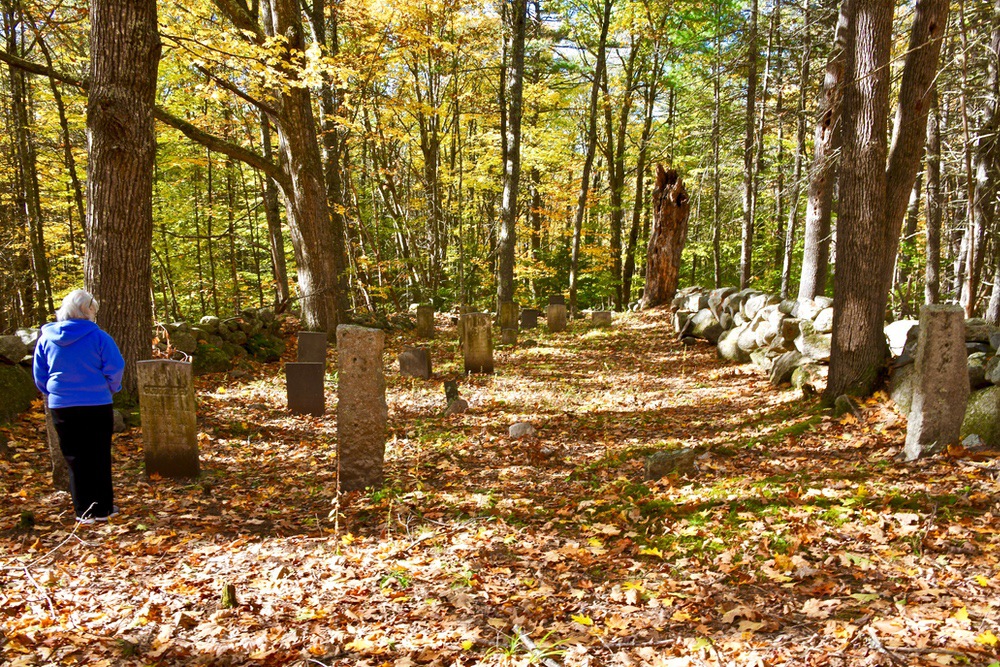
It was mostly in old, family cemeteries that we found graves of Revolutionary War soldiers. Last week my wife accompanied me on an exploration of rural Maine, one of my favorite activities. Since I’ve been up every road within a 25-mile radius of my home town of Lovell, Maine, It’s become necessary to range farther afield if I’m to survey new territory. Heading east, we found ourselves in the Hebron/Buckfield area with my dog-eared Maine Gazetteer. As a retired history teacher, I felt compelled to stop at every cemetery along the way because they provide a quick, thumbnail sketch of local history.


Well, I shouldn’t claim we stopped at every cemetery. From the road, I could tell if each set of plots was old or new. If I only saw modern, granite stones from the 20th century, I’d pass on by, but if I spotted weathering marble headstones, I knew they were from the 19th century. The oldest stones were dark slate and most of those were from the 18th century. Well-tended cemeteries displayed small American flags on graves containing veterans of America’s wars. Each flag was held up by an iron medallion stuck in the ground next to the headstone with an embossed insignia designating the war in which the soldier buried there fought.


Civil War veterans are so designated by an embossed circle with “GAR” in the middle for “Grand Army of the Republic.” Revolutionary War soldiers’ graves show a circle with a period soldier carrying a musket and wearing a tricorne hat. Some of those gravestones were of weathered marble if they survived into the eighteen hundreds, which many did. Acid rain has taken a toll on those stones, but the older, slate stones have held up well and the lettering remains easy to read.


Most roads lead into the center of town in Hebron which is dominated by the well-tended grounds and buildings of Hebron Academy. It was founded in 1804 by Revolutionary War veterans who were given land grants in town in payment for their service by Commonwealth of Massachusetts, of which Maine was a part — until 1820 when it became its own state along with Missouri. Notable Hebron Academy graduates include Leon Leonwood Bean, or L. L. Bean as he is better known, as well as Hannibal Hamlin who was Lincoln’s first Vice President. Other alumni include Freelan Oscar Stanley, inventor of the Stanley Steamer and Maine comedian Tim Sample.


Finding the grave of a Revolutionary War soldier in an untended cemetery off in the woods brought a certain sadness. While all veterans deserve respect, it seems the men who went out from their farms and shops and fought the most powerful military on earth deserve a bit more of it. They risked the most because even if they weren’t killed or wounded, should their side lose they would lose everything. The British weren’t kind to defeated rebels — as they’d shown over and over in Ireland. Those with the most property had the most to lose, and most who signed their names to the Declaration of Independence were men of means.


Those old, untended cemeteries were symbolic of something else that saddened me. They made me reflect on recent trends in public education, especially that study of the subject I taught. American History has been watered down by progressive educators both during my career and after. Fewer young people are learning what those first American rebels risked in the late 18th century when they demanded rights from England and staked everything they had on those demands. Few students today are taught what is unique about the United States of America — that no other country in history was founded on an idea.


That idea is that government exists to preserve our God-given rights to life, liberty, and the pursuit of happiness. How much happiness one obtains in that pursuit is usually gauged according to individual initiative and perseverance. That’s what those Revolutionary veterans fought for and that’s what has been preserved by veterans of America’s subsequent wars — those buried under the rest of the little flags in those old cemeteries.


Today’s students instead learn a history emphasizing America’s carbuncles as if the United States were the only country to countenance slavery. Ignored are historical facts showing that virtually all nations practiced it, including American Indian tribes living here before Europeans arrived. All that is ignored now as students learn about “white privilege” and old white guys who owned slaves. De-emphasized or ignored altogether are old white guys who led movements to abolish slavery and who died by the thousands in that pursuit.


Men buried in those old cemeteries were not perfect and neither was their country. Such a thing is impossible this side of heaven, but ours is the country likely to get closest — if we stick to the ideas upon which it was founded. Keep that in mind on Veteran’s Day, November 11th.