Showing posts with label Archaeology. Show all posts

Tuesday, December 01, 2020

DELIVERING FOR HELEN


Last week I took a load off my truck and off my mind. I delivered all the late Helen Leadbeater’s Indian artifacts and journals to the Maine State Museum in Augusta. The boxes I had packed up last summer filled my Toyota Tacoma. They comprised the result of thirty years of collecting and documenting Indian artifacts from the upper Saco River Valley. I was afraid my truck wasn’t big enough to fit it all in. I was also afraid all that stone weighed so much I might break a spring, but I made it.


There to greet me were Arthur Speiss, senior archaeologist at the Maine Historic Preservation Commission, and Paula Work of the Museum. When I asked Paula what was so valuable about Helen’s collection, she said there had been hardly any professional archaeological work done in my part of Maine and, though Helen wasn’t a professional, she was a very careful researcher who kept extensive records of what she found and where.


Though my tenure here in western Maine overlapped Helen’s, we never met. My sister-in-law collected with her in North Fryeburg’s fields after they were plowed and harrowed in springtime. My brother viewed the collection after being granted access by Helen’s son, Arizona Zipper, who inherited her property across from Fryeburg Academy. When I wrote about Helen’s collection in this column, AZ, as Arizona Zipper likes to be called, knocked on my door and invited me to see it as well.
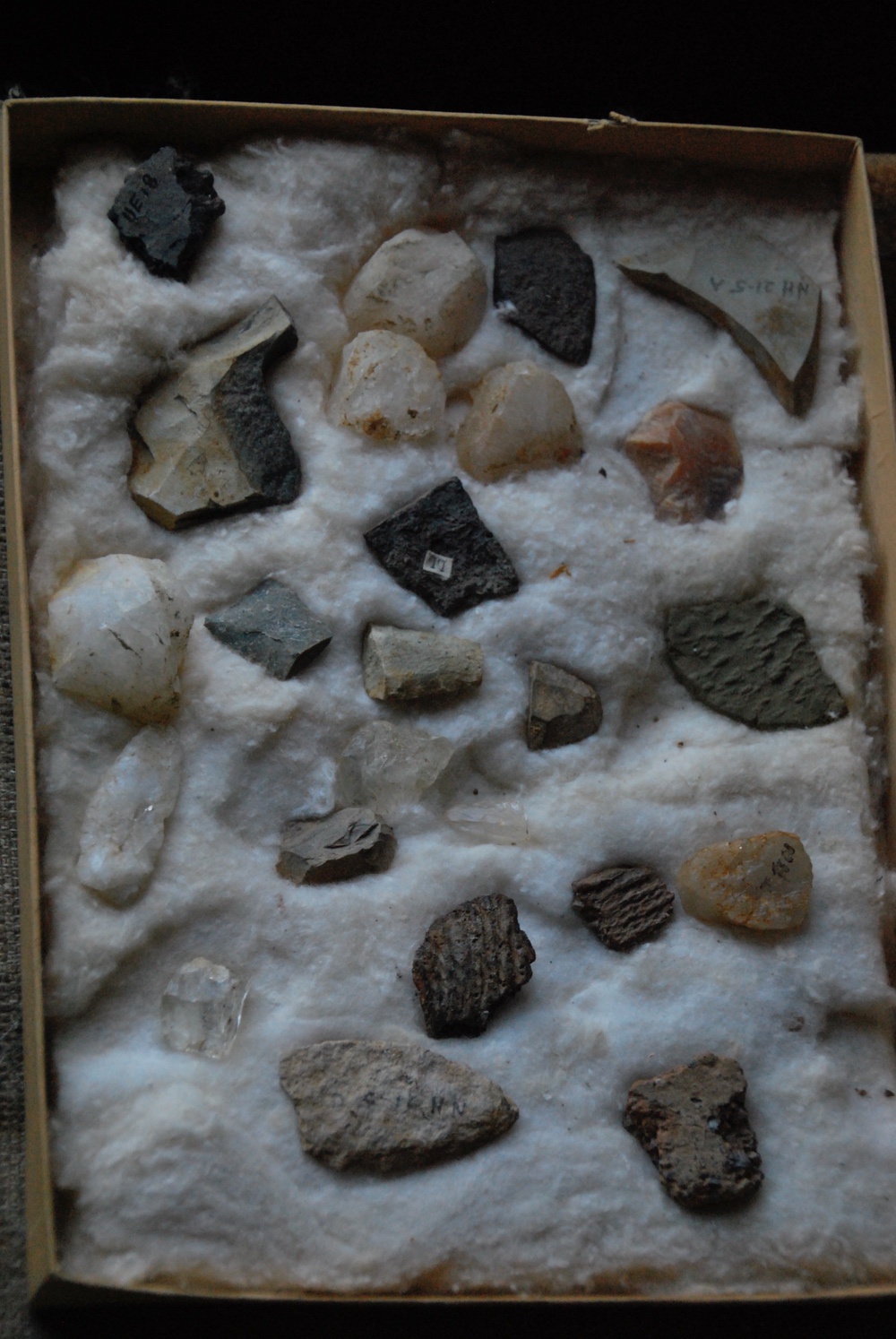


That was ten years ago when I was still teaching US History in Fryeburg. Virtually every archaeologist in the northeast had made the pilgrimage to Helen’s house, and one of them, Mike Gramly, asked me to inventory the collection for him. Gramly used to head up the Maine State Museum and the IRS recognizes him as an appraiser of archaeological collections like Helen’s. So, when I retired that became my first project. AZ gave me access again and I spent three weeks that first winter of retirement photographing her artifacts the way Gramly asked me to.


A local woman named Diana Bell heard about what I was doing and offered her assistance. While I photographed the artifacts box by box (Helen used hundreds of nylon stocking boxes to store them in), Diana scanned Helen’s notebooks and journals, which were also extensive. Thus I learned much about early human settlement of Fryeburg, Lovell, and Conway, New Hampshire. Helen published one scholarly article on pottery in the Maine Archaeological Society Journal in 1978.


A former student of mine named Bill Rombola had surveyed Helen’s collection during his archaeological study at the University of Southern Maine and published another article about in the journal in 1998. In it, Rombola reported that some of Helen’s artifacts were as much as 8000-9000 years old and were made from lithic (stone) material from New York, Vermont, Maine, Quebec and even northern Labrador (Ramah Chert).


AZ had little interest in his mother’s passion but he respected her work and wished to preserve it for study. His house is huge, difficult to heat and maintain, so for years he’s been considering a sale and a move to a smaller home. At one point, I was working with Dan Lee, former headmaster at Fryeburg Academy, to mediate a purchase of the home and turn part of it into a museum for Helen’t collection. AZ couldn’t pull the trigger on that so I began trying to convince him to let the Maine State Museum have the collection.


Last spring, he agreed under one condition: that photographs of Helen’s artifacts and digital copies of her journals be made available online as well as at the museum. I hurried to get his signature on a formal agreement to that effect from the museum and began to box up the collection. That occupied me last summer through some very hot, humid weeks getting it all packed and moved to a friend’s garage in Lovell. I also retrieved several boxes of artifacts that had been on loan to the Conway Library for exhibit.


Helen Leadbeater

In Augusta last week, Art and Paula helped me unload, and Paula showed me around the museum warehouse. I was thoroughly fascinated as only a history geek could be. On its moveable shelves were every historical collection about which I had been reading for decades! At one point we passed a drawer labeled “Michaud” which I knew to be a paleoindian site in Auburn, Maine. She pulled it out and let me hold a paleo projectile point over 12 thousand years old. It was quite a thrill. I said I wished I didn’t live so far away because I could spend months there totally enthralled. She said I’d be welcome anytime.


Wednesday, September 02, 2020

THE STONE


The Stone

Last week, I picked up a piece of stone from the ground in Fryeburg, Maine where a machine of some sort had cut into an old riverbank. It was unlike any other stones around it because it came from a cave on Mount Jasper in Berlin, New Hampshire forty-five miles away. Archaeologists and geologists call it “Mount Jasper Rhyolite” and Indians mined it for about 12,000 years or more.

In the hands of a skilled “knapper,” the stone can be fashioned into various tools useful to Indians who hadn’t learned to use metals here in what is now the United States. Everyone is familiar with arrowheads or spearpoints but probably wouldn’t recognize other artifacts that are much more common wherever Indians lived and worked, sometimes only seasonally, during prehistoric times in what is now Fryeburg.


What I picked up is a scraper. It was used, probably by a woman, for various purposes — most likely to prepare hides from animals brought to camp by hunters who used those other tools archaeologists call “projectile points.” There was no way for me to figure out how long the scraper had been there. It could have been used as recently as four or five hundred years ago, or it might have been used 10,000 years ago or more. Scraper technology hadn’t changed much over ten millennia.


Early Paleolithic type projectile point


Projectile point technology, however, had. I cannot say it advanced because there’s little agreement about that. We do know that it changed. The shapes of projectile points varied over millennia, but their function remained the same. They were hafted onto either an arrow, a spear, or a dart, but the hafts — and whatever material was used to attach the point to the haft — had long ago deteriorated. With relatively rare exceptions, only stone artifacts remain to be found here in the 21st century.


Calcine bone from the site


Those exceptions include something called “calcine bone.” Unless heated, bone will deteriorate quickly. When it’s heated sufficiently during the cooking process, it turns into calcine bone and can be preserved underground under certain conditions for millennia. Another exception is pottery. Though I didn’t find any yet at the site mentioned above, I’ve found many fragments a few miles away alongside the old riverbed. Archaeologists generally agree that American Indians learned to make pottery only about 3000 years ago at the beginning of the “ceramic age.”


Damariscotta Shell Heap


One more exception would include coastal sites where human and animal bone has been preserved under shell heaps, which are fairly common along the coast of Maine and the Maritime provinces of Canada. Bones going back a few millennia have been found under discarded shells of oysters and other shellfish. Some shell heaps like those found in Damariscotta, Maine can be quite large.


The Fryeburg site is new to me and I learned of it while reading notes and journals of the late Helen Leadbeater whose extensive artifact collection I’m packing up for delivery to the Maine State Museum soon. Although she didn’t say she collected there, she referred to others who had. It’s not ethical for me to disclose the exact location of any archaeological sites and I’ve pledged not to.


Though I’m tempted to scrape away at the raised riverbank where I found these artifacts to look for more, I resist. If I were to do so, I’d be obligated to conduct a dig according to strict archaeological guidelines which I have neither the time nor the inclination to undertake. I’m content to walk around and surface-collect and then figure out where the stone from which the artifacts were made originated.


This interests me. It’s a thrill to pick up something that hadn’t been touched by another human for hundreds or thousands of years. It’s also interesting to speculate about how the unusual stone — called “exotic” by archaeologists when the source is hundreds of miles away — got to where I discovered it. The Mount Jasper rhyolite came from Berlin, NH forty-five miles away as stated, but Berlin is on the Androscoggin River, but I was collecting on the bank of an old channel of the Saco River.


Inside the cave at Mount Jasper


I also found small flakes of of the same stone as the scraper which indicated that tools were manufactured on the site, or sharpened at least. These are clues about whether Indians habitually used the site or if it were a temporary encampment. Also visible were what archaeologists call “fire-cracked rock” which are associated with hearths. Indians used river cobbles to surround fire pits the same way campers do it today. Continued use of the same hearth caused the stones to redden and crack.


All this fascinates a history geek like me and I’ll definitely return to the site as time permits to see what else turns up.


Tuesday, July 17, 2018

Jefferson NH Paleoindian Sites


NH Archaeologist Dr. Richard Boisvert
at one Jefferson site

It’s a risk to say they were the first humans in New Hampshire. Better to qualify and say instead something like: “Evidence indicates they were the first.” Because who knows? Some time in the future evidence of an earlier people may be discovered. I’m referring to those people most archaeologists call “Paleoindians.” At least one archaeologist I’ve spoken to, however, prefers the term “Paleoamericans” because that leaves open the possibility that the first humans in New England may not have been Indians, people whom those the rigidly, politically correct would call Native Americans.


There are relatively recent theories afloat that the first Americans may have come from Europe — across the Atlantic on the southern edge of glaciers that covered both the North American and European continents during earth’s most recent glaciation — the Pleistocene Epoch. The period after which those glaciers retreated from what is now Maine and New Hampshire is called the “Holocene.” which began around 12,000 years ago and still extant. Paleoamericans left evidence that they were here immediately following glacial meltdown.


The most interesting of recent Paleoamerican discoveries I know of are in Jefferson, New Hampshire. Those excavations have taken decades but the most recent was during the summer of 2017. All that can be found after twelve millennia are stones, or “lithics” in archaeological parlance, because the organic material has long dissolved. Sources of the stone preferred by those ancient humans for toolmaking are scattered over Maine and New Hampshire but was mostly local for the Jefferson site at least. Availability of that stone may have been one of the reasons Paleoamericans visited.


The various Jefferson sites are close to Mount Jasper, about which I’d previously written here, and the Jefferson stone closely resembles Mount Jasper rhyolite. Excavations conducted at the various Jefferson sites have been under the supervision of Dr. Richard Boisvert, the soon-to-retire New Hampshire state archaeologist I had a chance to interview in June of last year. Boisvert is especially interested in the paleo period and I am too, so I was thrilled when he agreed to meet with me. I’ve read everything I can find on Maine and New Hampshire sites, some of which he authored.


Boisvert believes those early New Hampshire residents made clothing there. “How do you know that?” I asked, given that he has only stones to study. Well, his team found many artifacts called “gravers” which are flakes of “knappable” stone — stone which can be shaped by skilled artisans who strike it with other stones or with pieces of antler to produce a sharp edge for knives, projectile points, scrapers, and “gravers.” Gravers have a sharp point, not unlike a linoleum knife but smaller, and the point can be used to make the eye of a needle. Bone needles have been found at sites not old enough for organic material to have disintegrated.


The various Jefferson sites had at least one thing in common: they overlooked what was probably a game trail along which caribou traveled (and perhaps now-extinct megafauna as well). The proliferation of gravers indicates needle making which, in turn, indicates clothing manufacture. The proliferation of stone scrapers found there would support that hypothesis because they were used to remove residual flesh inside flensed animal hides.


Dating the artifacts is done by consultation with other scientists such as geologists and botanists. Geologists analyze the post-glacial landscape, some of which had been lake bottom. Enormous amounts of water flowed from melting ice still retreating northwestward at the time and dams sometimes formed in valleys creating lakes. Many were temporary when dams failed and water drained through breaches. In some cases, smaller lakes and ponds remain to the present day and botanists analyze pollen samples from lake-bottom sediments. Thus they can determine climate conditions of 12,000 years ago by what kinds of plants produced the pollen.

Notice central groove or "flute"
The Jefferson sites are forested now, but during the paleo period there were no trees and paleo hunters could have seen migrating herds miles away. They fashioned the distinctive, “fluted” spear points characteristic of the paleo period with which to kill them. Boisvert found other small bits of stone called “channel flakes” which are struck from those points to create the central groove or flute created for hafting. Boisvert said his team found 126 such channel flakes indicated extensive spearpoint manufacture.
My wife and I visited Indian sites in the southwest just before I interviewed Boisvert. Artifacts are plainly visible on the surface there because there’s so little vegetation to obscure them. The first paleo artifacts were first discovered in Clovis New Mexico in 1929 and were dated to about the period of the Jefferson, New Hampshire artifacts. Clovis fluted points have since been found all over North America.

Tuesday, January 21, 2014

Just Another Rock? Nope


Rocks interest me. Always have. One I picked up last spring from a banking that led down to Willard Beach in South Portland has been in the pocket of the fleece I was wearing ever since. It’s very familiar to me now because I feel it every time I put that fleece on. My thumb goes carefully across its sharp edge, just as one might feel the edge of a sharp knife. The rest of the stone fits my thumb and index finger fairly comfortably - just as I believe it fit into the hand of at least one other person hundreds - perhaps thousands of years ago. It’s a prehistoric tool. It isn’t a JAR - “Just Another Rock” - in the parlance of some Maine archaeologists with whom I’ve worked.
A little of Fort Preble and Portland Harbor in upper right

Waves from winter storms had worn the banking away and exposed strata in an area I knew had been settled very early by some of the first British colonists in Maine. Just above the bank is a cemetery established in 1658, which is on the campus of Southern Maine Community College now. It was March, and thick vegetation that grows there in summer hadn’t sprouted yet, so I climbed up for a close look. Just beneath the turf were late-20th-century artifacts like detachable pop tops from aluminum cans. Old enough to remember those? I am. Layers below that showed pieces of red brick that could have gone back from the 20th to the 17th century. There were pieces to old ceramic dinner plates and crockery interspersed with them, so I concentrated on the layers below. I was looking for prehistoric stone artifacts.
Shipping channel just off Willard Beach

Certain kinds of stone were favored by prehistoric Americans and quartz was one. It’s the most difficult stone to shape into a useful tool by knapping - that method of striking that chips off pieces in predictable ways - but quartz will hold an edge better than others. It’s very hard, and it’s ubiquitous in Maine. There are seams of quartz in the metamorphic sedimentary rock one sees all along Maine’s coast, so when I saw a small piece sticking out of the bank, I picked it up right away. Unlike jasper and rhyolite and flint, which are stones also favored by Maine’s early inhabitants, white quartz doesn’t change appearance much from weathering. Even very old pieces are fairly easy to recognize.
White quartz outcropping just below the banking

I’ve picked up lots of prehistoric quartz tools in the Fryeburg area along the Saco River over the years, but this was the first I’d found in the Portland environs. There are plenty of potential sites to explore in that area, but there’s been so much building and re-building over almost four centuries of the historical era that finding prehistoric artifacts is much more difficult. I’ve found artifacts further up Maine’s coast where there’s been very little development. It’s relatively easy to find small shell heaps above the high tide marks further east just by walking along - if you know what to look for. My wife usually accompanies me  at such times and she’s learned to be patient. She likes to pick up shells and rocks with visual appeal while I search for artifacts. I like those pretty rocks too, but they don’t interest me nearly as much as stone worked by prehistoric Americans.
Southern Maine Community College last summer

Some of you looking my piece of quartz may think: “No. That’s just another rock.” When as a kid I saw pictures of similar artifacts in National Geographic - picked up by archaeologists who claimed they were tools. I was skeptical too. They looked like ordinary rocks. After a few years of studying knapping techniques and some field work, however, I’m better at distinguishing an artifact from a “JAR.” When walking near a river or beach these days, I’m always picking up stones and looking them over. When I find a stone artifact, I imagine the landscape as it looked when the last human being handled it.

Scooped up by a dragger off Bass Harbor (photo by Joe Kelly, University of Maine)
It’s somewhat frustrating, however, when I realize that most of the earliest prehistoric sites along Maine’s coast are very likely underwater now. Sea levels were much lower 12 thousand years ago when the last glaciers melted away from Maine and the people who were probably Maine’s earliest inhabitants likely gathered their seafood along a coastline that is now deeply submerged. Draggers occasionally bring up stone tools from the Gulf of Maine and elsewhere along America’s Atlantic coast. Exploring those sites would be much more problematic though, so I guess I’ll stay on dry land when pursuing my avocation - looking for prehistoric stone artifacts.

Wednesday, June 26, 2013

Grave Matters

Digging someone’s grave is an intimate thing, and I’ve done it twice now in just over a year. I’d buried pets like frogs and turtles when I was a boy, and a dog when I was an adult, but never a human being. I’d asked the caretaker at the small, private cemetery what rules or regulations there might be, which were very few. So, I loaded a couple of shovels into my truck and drove over the day before the funeral last spring.

My brother, Dan, died in Florida during March of 2012 of a chronic disease we both struggled with for years. He had lived a long time in North Fryeburg and, knowing death could come soon, told his wife of his wish to be buried there. He’d been cremated and she flew up with his ashes, so I didn’t have to dig a very big hole. She’d asked me to make a box for his urn and that, too, was a solitary, intimate experience.
Mark Woodbrey at Lovell Lumber

Once I had the urn’s dimensions, I went to Lovell Lumber and bought a ten-foot, one-by-twelve pine board. The mill owner, a fellow about my age, silently wrote out the slip for my meager, one-board purchase. “That’s all?” he asked, so I explained what I was making. He paused and looked up at me with a surprised expression and told me he had done the same thing for his brother.

“Hmm,” I said.
St. William's School Tewksbury, MA
 
Back in my garage, I thought about the carpentry projects I’d done for my brother because it wasn’t one of his skills, being in the plumbing and heating business. This would be the last. I wondered if he were observing me while I worked. He was my little brother and we shared a bedroom for many years. I protected him growing up in the neighborhood. As adults we perceived world quite differently in many ways and there were subjects I’d learned to avoid discussing while he was alive. That didn’t matter any more. “Ashes to ashes,” we were told by the nuns at St. William’s School, “dust to dust.” He had come to it sooner than I did.

My Uncle Joe's funeral last year

I’d been to professional funerals where artificial turf covered the excavated soil and edges of the hole, and with a stainless steel frame onto which the casket was placed and lowered by pulleys into a concrete vault. Backhoes dig those graves these days. I was doing it the old-fashioned way, alone with a shovel. Geese flew by in single-line flight, honking. Nature’s seasons mirror life’s seasons. Many poems, many songs compare them. My brother died in what should have been the autumn of his. His wife asked me to deliver his eulogy as well and I pondered that as I made the box and dug the grave. I knew that would be the hardest task because remembrances of my brother would not longer be my own private thoughts and feelings. I’d have to speak them in front of everyone.
This past spring, his son and my nephew, Danny Boy as we called him, died suddenly, also in Florida. The postmortem showed an enlarged heart. My wife and my sisters remembered how sensitive he was as a boy to the needs of his many younger cousins in our extended, Irish-Catholic family. Enlarged heart indeed. He was very gentle, and the world has a way of eating up those whose hearts are too big. The hundred-year-old Irish-American song “Danny Boy” is about a boy leaving his father in Ireland for America and how they may never see each other again. I thought about those lyrics as I dug still another grave uniting Dan and Danny Boy in death.
The area around the cemetery is familiar. I’d collected artifacts there over the years - remains of Indian occupation going back several millennia. If they buried their dead there too, evidence would have disappeared long before. That wasn’t likely though, given that the site was in the Saco flood plain and would have been under water in springtime, so their occupation was likely seasonal. All that’s been found were stone tools, hearths with charcoal, and calcine animal bone preserved by fire.
Cemetery on left, Old Saco on right

Conscious of that, I scrutinized each shovelful of soil but I found nothing in my brother’s grave last year. When I dug his son’s grave right next to it two weeks ago, however, I found chips of Mount Jasper Rhyolite from Berlin, NH just under the turf. That told me it was a toolmaking site many, many centuries ago. Both graves looked just like test pits we’d excavated four years previous within sight of where I was digging with a team of archaeologists and students.
Students in the test pits

British colonists and we Americans who derived from them have been in this area only 250 years or so. Artifacts I’ve found on that side of the Old Saco River go back about eight hundred, probably left by ancestors the Abenaki. Others have been found across the river going back several thousand, and we know relatively little about the people who made them. All civilizations eventually fade away and ours will as well. We’re all going to die of something, sooner or later, and being mindful of that enriches each new day. How we live those days determines how we’ll spend eternity. Meanwhile, a bit of a respite from graves, funerals and eulogies would suit me.

Tuesday, August 21, 2012

Historic Controversy


I spent decades teaching US History and stayed at it so long because I loved it. Still do. I’m a history geek, and a recent book about where early Americans came from has me all excited. It’s called “Across Atlantic Ice,” and it’s shaking up the history world.

The new theory is that at least some early Americans arrived from Europe across the Atlantic along the edge of pack ice during the last glacial maximum - that period 22,000 years ago or so around the time when the Atlantic would have been frozen furthest south. Every US History text I’ve ever used taught that the first Americans came across a land bridge from Asia - where the Bering Strait now separates the two continents - no earlier than 14,000 years ago, as if were established fact. That always bothered me, because we simply couldn’t know that for certain. When I was teaching, I’d always point out to students that their textbook was making an unsubstantiated claim. Evidence pointed in that direction, yes, but it wasn’t a certainty. While it is proven that some early Americans migrated from Asia, we simply couldn’t be sure that they were the first to come here. I’d always caution students to qualify such a claim by saying something like: “As far as we can tell . . . ”The general rule of thumb would be that the further we go back in history, the less we can be sure of. When we’re trying to figure out what happened tens of thousands of years ago, it’s mostly speculative. The authors of “Across Atlantic Ice” are nothing if not humble. The book is filled with qualifiers because it’s authors know their idea is a theory, and because professionally, Dennis Stanford and Bruce Bradley are sticking their necks out. Because he’s Director of the Smithsonian’s Paleoindian/Paleoecology Program, Stanford’s book has to be taken seriously in the archaeology community. His and Bradley’s theory isn’t new, but until now, the case hasn’t been put forth as comprehensively as they have done, so there’s lots of heated discussion. That’s as it should be in any scientific or academic community.

Those who insisted that people from the so-called “Clovis” culture were the first Americans, and that they came exclusively from Asia after the 14,000-year mark, are the most threatened by “Across Atlantic Ice,” and it’s time they were seriously challenged. Even though evidence of previous Americans hadn’t shown up until relatively recently, the “Clovis First” crowd should have understood the possibility that it might. Because there’s no evidence for something doesn’t mean it never happened. Because we’ve found no remains of boats from 22,000 years ago doesn’t mean there weren’t any. They would have been made of perishable materials like wood, animal hides and such and wouldn’t be preserved except under unusual conditions. The authors contend that Europeans came along the ice margin in small watercraft while hunting marine mammals much the way the Inuit did in historical times.Stone, or “lithic” material as archaeologists call it, has been preserved, and Stanford and Bradley are expert at gleaning information from stone artifacts. Most evidence in support of their theory comes from examining techniques of shaping stone into usable tools.Those early Europeans who allegedly crossed that Atlantic ice are known as Solutrean and they were masters at working stone and other materials. The earliest identifiable sewing needles were found at their habitation sites. I never realized how much skill went into the manufacture of stone knives, scrapers, arrowheads and spearpoints until I read “Across Atlantic Ice.” It was Solutrean techniques showing up in North American artifacts that first caused archaeologists to theorize about migration to what is now to the United States from Europe during the end of the last Ice Age. Methods for making artifacts earlier archaeologists labeled “Clovis” may well have come from Europe and not from Asia as first thought. Solutrean-like artifacts showed up on this side of the ocean but the stone they were made from came from North America. If a Solutrean point were to appear made of stone from Europe, well, that might be enough to convince skeptics.So, when a Solutrean point found in Virginia in 1971 was determined to have been made from a flint originating in France, it looked like proof. However, it was found near the remains of a colonial era home and could have been carried over during historical times, so it’s not the smoking gun it might otherwise have been.Meanwhile, the research continues. Exciting times in the history-geek community.