Tuesday, September 24, 2019

At the Highland Games in Lincoln, NH


Binary isn’t a dirty word among the Scots. Yes, many of the men wear skirts, but it wouldn’t be a good idea to question the masculinity of a kilt-wearing man at the recent Highland Games in Lincoln, New Hampshire. Generally, I hate crowds, but I willingly endured the throng that turned out for the Scottish soiree last Saturday. The first thing I did was visit the exhibit tent of Clan MacLachlan [Gaelic spelling for McLaughlin], the Scottish branch of my ancestors. 

Old Castle Lachlan on Lachlan Bay in the Scottish Highlands
Gaelic Scotland was settled from northern Ireland. If you stand on the shore of County Antrim in Ulster on a clear day, you can see across the Irish Sea to Scotland. It’s that close. Just to the west of County Antrim is the Inishowen Peninsula where the largest Irish branch of the clan still lives and where my great-grandfather was born. The July/August 2001 edition of Archaeology Magazine explains it this way:
Ireland in the Early Christian period (A.D. 400-1177) was made up of at least 120 chiefdoms, usually described in surviving documents as petty kingdoms, typically having about 700 warriors. One of these petty kingdoms was Dál Riata, which occupied a corner of County Antrim, the island's northeasternmost part. Around A.D. 400, people from Dál Riata began to settle across the Irish Sea along the Scottish coast in County Argyll. Other Irish migrants were also establishing footholds along the coast farther south, as far as Wales and even Cornwall, but the migrants from Dál Riata were especially noteworthy because they were known to the Romans as "Scotti" and they would eventually give their Gaelic language and their name to all of what is now known as Scotland.

 There remain Gaelic-speaking areas in Brittany too. They’re all Celtic, the last vestiges of the ancient tribe the Greeks referred to as Keltoi, or “tall ones.” The Romans called them “Gauls” and Julius Caesar said they called themselves “Celts.” Their original language will likely join Latin as a dead language in just a few more generations. The “tall ones” characterization describes many of the men participating in the Highland Games, the events of which involve the lifting and throwing of various heavy and awkward objects including stones and logs. At 6’5” and 300 lbs, the contestants were as big and brawny as NFL linemen, and they were all wearing kilts.


Clan pride is still fierce — kind of an extension of family honor, and leading, I think, to national pride. Each clan has its own “tartan,” a unique plaid fabric with certain interwoven colors, configurations of which are “owned” by the clan and used to sew kilts, hats, and an over-the-shoulder sash such as you’d see watching movies like “Rob Roy” and “Braveheart.” Also unique to each clan is its heraldry displaying elements of clan history and a slogan. For Clan MacLachlan, the slogan is “Fortis et Fidus,” which means “brave and faithful.”
Men wearing kilts at the Highland games had a confident bearing as if they had internalized Rule #1 of Jordan Peterson’s Twelve Rules for Life: An Antidote For Chaos. “Stand up straight, shoulders back.” They looked straight ahead. They made eye contact. They knew who they were. So did the women.

Isle of Skye Scotland
Another recent book came to mind as I observed people in the crowd. That would be the just-published Primal Screams by Mary Eberstadt, who claims the sexual revolution and related social upheaval of the sixties in America have “… whittled away at our primary attachments [and] have by now deprived a great many people of traditional answers to the question, ‘Who am I?’ These traditional answers involve our relations to others: I am a sister, mother, aunt, cousin, wife, etc. We define our identities relationally … But for a lot of us today, thanks to family vanishing, those fundamental familial building blocks of identity are harder to come by.”
Dancers with the RCMP Pipe and Drum Corps in Lincoln
Belonging to a clan adds another strong layer to all that. Those in attendance at the Highland Games in New Hampshire last weekend were roused by the frequent and riveting rhythms of pipes and drums, symbolic of Celtic heritage. It stirred something deep within me as if it were energizing my DNA. And, who knows? Maybe it was. I felt a certain pride — like I belonged to an ancient and esteemed tradition.

Spontaneous dancers at Albannach performance

Performances including formal marching pipe and drum bands like one from the Royal Canadian Mounted Police as well as more primal groups like Albannach, which is Gaelic for Scottish. Albannach really got the blood running in the tent where they put on their show. It was quite infectious. At one point they brought a young bagpiper on stage who couldn’t have been more than five years old. He had to stand on a box so the crowd would see him.

The young bagpiper


Monday, September 16, 2019

New Maine Residents


It’s no big deal to see a wild turkey in Maine anymore. They’re as common as crows these days, but it hasn’t been that long, and I remember the first time I saw one around here. My wife was driving a little school bus in nearby Sweden, Maine when she saw one acting funny beside Knight’s Hill Road after dropping off her last student. Thinking it injured, she took it into the bus and brought it home. I’m not sure I could call it wild though, as it seemed unsure of itself — as if trying to decide whether it was wild or domesticated. That wasn’t too long after Maine had first reintroduced turkeys here in 1978. Now, of course, they’re prolific.

Bald Eagle and Osprey over Kezar Lake
Seeing a bald eagle is becoming routine too. The first time I ever saw one in Lovell, Maine, I saw two. Was it twelve years ago? Fifteen? I’m not sure, but I was doing the dishes at the kitchen sink and noticed two large birds circling each other very high up. I had to squint to notice the white tails, then the white heads. A few years later I saw one in a kind of aerial dogfight with a much smaller osprey over middle bay on Kezar Lake in Lovell. More recently I saw one perched on a branch beside the lake trying to eat a fish as it was being harassed by smaller birds. He flew off clutching the half-eaten fish while being dive-bombed by those pesky little birds.

Harassed Bald Eagle over Kezar Lake
I still stop and stare when I see a bald eagle today because they’re just so majestic, and there aren’t that many of them around yet. About six weeks ago, I saw my first golden eagle soaring above the Spurwink River estuary at Higgins Beach in Scarborough, Maine. I had my 150-600 mm lens with me because I was planning to photograph arctic terns as they dove for small fish. They weren’t active that day and I was about to head back to my vehicle when this huge bird appeared over the water. Someone had told me that goldens are bigger than bald eagles and I figured that must be what I was looking at through my lens. It was huge.
Golden Eagle in Scarborough, Maine
The big bird flew in slow circles looking down to the surface of the estuary for his lunch. He evidently didn’t see anything catchable so he flew back to a perch on a limb on the other side of the river mouth. He was in shadow and I couldn’t get a decent shot of him over there so I waited for him to come back out and go fishing again hoping to get a shot of him diving down and grabbing one. Unfortunately, he never emerged before it was time for me to leave. As soon as I got home I downloaded the images and researched golden eagles to make sure of my identification. It was definitely a golden eagle.

Golden Eagle in Scarborough, Maine
So far I’ve only seen opossum as roadkill here in Maine and have yet to see a live one. It shouldn’t be long before I do though because the roadkill was less than a mile from my house. He wasn’t just “playing possum” as his entrails had burst out over the pavement. Guess I’ll have to study up on their habits so I can hopefully get some shots of a live one.


Last fall I saw a small flock of tannish, heron-like birds with red markings on their heads in the back of a large farm field in nearby North Fryeburg, Maine. I wasn’t sure what they were, but when I saw a notice on Facebook of Maine sightings of sandhill cranes this past summer, I realized what they were. Two weeks ago, I was looking for Indian artifacts along the course of the Old Saco River when I heard their distinct, high-pitched “kuk-err, kuk-err” emanating from a nearby field. I went back to my truck, attached the long lens to my camera, and drove over there.

Sandhill Cranes in Fryeburg
They must have heard me coming because all six or seven of them had turned their heads my way from across the field. I emerged, camera-ready, from my truck and walked slowly toward them. “Kuk-err, kuk-err,” I heard again as they got agitated. I kept walking in their direction until they took off, chattering as they cleared the treetops separating that field from the next. According to an article in the Boothbay Register, there have been nesting pairs of sandhill cranes in Maine since at least the year 2000.

Sandhill Cranes in Fryeburg
It’s big and bulky, but I’ll definitely be packing my long lens on future trips to North Fryeburg — or anywhere else in Maine for that matter. I got myself a larger backpack capable of carrying all I’ll need to photograph all the new residents of our state.

Saturday, September 14, 2019

Left & Right September 11, 2019


Occupying the left chair for this show is my old friend, Jim Wilfong. He's a Democrat former Maine state representative, a selectman in Stow, Maine, a former Small Business Administration official in the Clinton Administration, a former trade advisor for the Bush and Obama Administrations as well as other titles which you can see at the beginning of the show. I hope he'll come back for future shows as well.

The first question from the producer asked if we think it was appropriate for President Trump to have the Taliban on US soil during the week of 9/11. Jim did not and neither did I. From there, we discussed Afghanistan both historically and today. We discussed where each of was on September 11th.

We discussed how some aspects of the long Cold War between the US and Russia continue. Jim claims our #1 export is weaponry, which was surprising to me. We discussed the positive and negative aspects of that.

From there we discussed the Democrat field of candidates for president, and I recalled Jim's early support in the 1980s of Joe Biden. Now he's intrigued by Andrew Yang and Elizabeth Warren. Yang because of his discussion of technology's impact on employment, especially in the future. He likes the way Warren is critical of Wall Street and big business, him being a small business guy.

Jim goes into the feasibility of alternative energy sources in light of the importance of fossil fuels in developing third-world economies.

I call attention to the rise of socialism in the Democrat Party, especially polls showing a majority of young Democrats favoring socialism over capitalism. I cite Alexandria Ocasio Cortez's election and Democrat chairman Tom Perez saying she's the future of the party. I cite her chief of staff's claim that the Green New Deal is primarily a vehicle to take over the US economy, and not a remedy for climate change.

Jim says the future direction of the Democrat Party remains to be seen, that political winds shift quickly. I hope he's right, but I'm not so sure. He's optimistic about young entrepreneurs he's working with and sees them as capitalists with a concern for their community. I take that to mean that believes free enterprise will prevail among the young so long as small business survives as a big part of our overall economy.

We reflected on the benefits of teaching for a long time in the same community. We get to meet with them and hear from them as they become adults and work in the community.

We end with me citing recent New York Times news-shaping strategies as revealed by a transcript surreptitiously recorded and published in Slate Magazine. We speculate about what news outlets come closest the ideal of straight news sans opinion.

Thursday, September 05, 2019

The Widening Generation Gap


Solid evidence has arrived to confirm what many feared. Despite what has been visibly obvious for the past several years, many held out hope that it really wasn’t so bad, or that it was only temporary and would eventually turn around again. The results of an NBC News/Wall Street Journal poll last week dispelled that hope. They were a reality slap and a very painful one at that.


According to the poll, nearly four out of five Americans aged 55+ consider patriotism a strong value, but only about half as many millennials believe that. Two out of three aged 55+ believe religion/belief in God very important, while fewer than one in three millennials do. Lastly, desire for children is way down too. Most 55+ Americans consider having children very important, but fewer than one in three millennials do. There is a little good news, however. Most of us still value hard work, community involvement, and tolerance for others.


The values my generation (I’m 68) considers essential for the continued survival of America as we know it are dying and will soon expire along with us. As conservative essayist Rod Dreher put it: “Those under 40 don’t believe in God, their country, or having children (which is to say, the future), but they do believe in fulfilling themselves. They have nothing to live for except themselves and their jobs.”


While millennials believe in hard work, what about the fruit of their toil? If their money isn’t spent raising a family, what is it for? If it’s not donated to a church, where does it go? Do millennials spend it all on themselves? And why don’t they want children? It’s a question I’ve visited in this space often over the past twenty years. Asking millennials why they eschew raising a family, they cite the high cost of children — a claim for which there is much evidence. Others point to the huge sacrifice of time and energy. Still others want to avoid pregnancy because it can cause stretch marks and sagging breasts.


Also released last week was a very insightful book by essayist Mary Eberstadt called Primal Screams, a collection of essays by several authors which attributes the rise of identity politics to many of the trends highlighted in the above-mentioned poll. During an interview with Kathryn Lopez in National Review, Eberstadt claimed that Americans are becoming more tribal as family support diminishes. They identify with others of their race, sex, and sexuality and Eberstadt claims these trends result from the sexual revolution and social upheaval of the ’60s and ’70s.


When asked what the connection is, Eberstadt said: “In part, it’s simple arithmetic. Think of all the post-revolutionary phenomena that are quotidian facts of life. Abortion, fatherlessness, divorce, single parenthood, childlessness, the shrinking family, the shrinking extended family: Every one of these developments has the effect of reducing the number of people whom we can call our own. And since we are relational creatures, the result is a great vacuum. That’s a lot of what the increasingly panicked flight to collective identities is about.”


As an undergraduate sociology major in the seventies, I recall my left-wing professors still referring to the family as “the basic unit of society.” I doubt sociology departments would countenance that assertion today. Eberstadt points to recent confusion about “gender identity” stemming from the same source. Social upheaval starting in the sixties, she said: “… whittled away at our primary attachments [and] have by now deprived a great many people of traditional answers to the question, ‘Who am I?’ These traditional answers involve our relations to others: I am a sister, mother, aunt, cousin, wife, etc. We define our identities relationally — as the popularity of 23 and Me indicates; as the well-known search for biological relations by children of anonymous sperm donors also affirms. But for a lot of us today, thanks to family vanishing, those fundamental familial building blocks of identity are harder to come by.”


They are indeed. Throughout my long teaching career I assigned students to interview someone seventy or older and ask them: Do you think it’s easier for children to grow up today compared to sixty years ago? Elders said it was easier back then because everyone had the same values. Other questions included: How many brothers and sisters did you have? How many children did the average family have when you were growing up? Did you know any couples who got divorced? To that last question, the answer would often be: “No. I didn’t know anyone who was divorced.” I wanted students to understand, first hand, that it didn’t use to be this way.


The great unraveling began in the late 20th century and continues at an accelerated pace today. Not only are we unable to answer the question “Who am I?”; we can’t even figure out if we’re male or female — or something else entirely.

Tuesday, August 27, 2019

With A Master On The Mountain


Babb's "Copley Plunge" Boston Museum of Fine Art
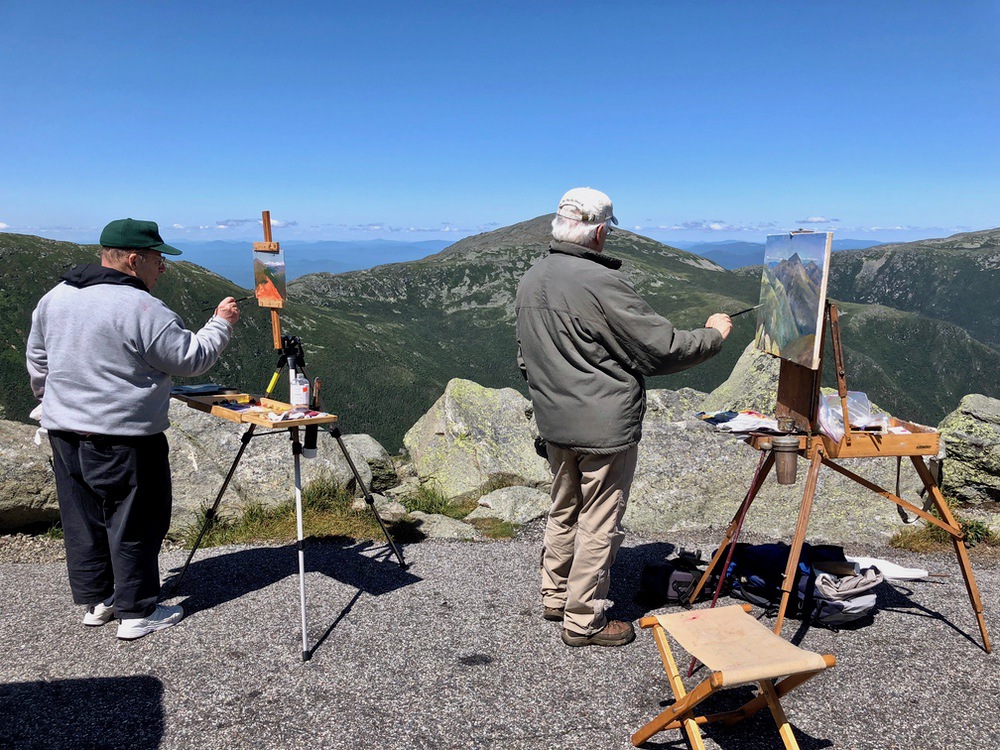
When I contacted Seth Lipsky, a summer friend from New York City who has a place in Waterford, Maine, he suggested we have an early breakfast in Bethel. He had plans to meet another friend there, then go up Mount Washington to paint. As we finished eating, in walked none other than Joel Babb of Sumner, Maine, an accomplished painter of Roman and Boston cityscapes, interior and coastal Maine scenes, as well as other subjects. I was thrilled to meet him because I’ve been admiring his work ever since the Portland Press Herald did a big spread on him exactly a year ago. I saw his exhibition at Portland’s Greenhut Gallery this summer and was sorry to miss his talk there a month ago.

Babb's “Bernd Heinrich’s Brook” 40 by 52 inches
Seth is the founder and editor of the New York Sun, an independent conservative daily paper in New York City that published in hard copy for several years and continues to exist online. Seth has time to paint now and met Joel in that pursuit. I had told him of my recent photographic ventures which led to my interest in Babb because I had shot some of the scenes he painted in Rome and in Maine. I was doubly thrilled when both invited me to accompany them on their artistic expedition. I wasn’t dressed for a day on “the rock pile,” as locals refer to Mount Washington, but Seth said he had an extra slicker in his car so off we went. I left a voice mail for my wife as we drove.
Seth and Joel on the rock pile
Each artist had already started two canvases — one from around the 4000-foot mark and another from 6000, both looking north toward Mount Adams. Joel often works from photographs, but these were plein air style (in the open air). They let me watch, take pictures, and ask questions as they discussed how to mix various colored paints to match the gray stone piles and dark green fir trees on the slopes, as well as the blue sky and white clouds beyond. Several tourists stopped to watch them work. The ever-gregarious Seth conversed with them, describing Joel as the master and himself as acolyte. Babb certainly is that. It’s hard to tell his work is a painting and not a photograph. It’s that good.


It was a lovely day, cold at first and a bit breezy, but the sun was strong and it soon warmed enough that I only needed a light fleece to stay comfortable. Only once before had I been on the Mount Washington Auto Road and I had vowed never to drive it again. Steep, narrow, winding roads with near-vertical drop-offs give me the willies, as they did in the west of Ireland earlier this year. Seth drove, however, and it didn’t seem to bother him. He has a season pass and goes up there a lot. I sat in the back and sometimes had to close my eyes. 
The artists discuss colors
Knowing nothing about oil painting, I was continually impressed by their strenuous efforts to render the scenes before them just as they existed. They scrutinized each facet of the view much more closely than I ever do with my camera and conditions changed by the hour as the sun moved. Joel pointed to a patch of snow on one of the canvases he had begun back in July. He wasn’t satisfied with his shades of green on the fir groves and worked to mix more colors to strive for a closer match. I felt privileged that they both answered my questions and I tried not to be a pest.

His paintings at Greenhut Galleries in July were priced in five figures, while I only charge $300 for one of my photos. He asked how my sales were going and I told him selling my stuff was a new endeavor and I only photographed only things that interest me -- and I resisted requests to do otherwise. At that he raised his white eyebrows, saying, “You turned down commissions? You know, Leonardo said once: ‘Give them a few virgins. Then paint what you want.’” Babb had studied Da Vinci extensively during his year in Rome. Like him, he attended dissections at BU Medical School to understand musculature — although Da Vinci had done the dissections himself.

Da Vinci anatomy drawing
Seth and Joel both immersed themselves in their work. For Joel, though, it’s total immersion and has been for decades. He majored in art history at Princeton, but decided to be an artist instead of an historian. He said only two others in his class had done so. At about three in the afternoon, I helped them carry their equipment back to Seth’s minivan and we drove back down the rock pile. Again I closed my eyes at precarious points but Seth remained undaunted.


As we each walked to our vehicles at the bottom, Joel invited me to see his studio in Sumner. I intend to take him up on that sometime this fall.

Tuesday, August 20, 2019

Portland Maine Students Vote With Their Feet


Deering High School
School choice is a good thing, and it is highlighting problems in Portland, Maine. The city has two large high schools and students can attend whichever one they choose. The Portland Press Herald ran a series of articles over the summer indicating why so many students and their parents are choosing Portland High School over rival Deering High School. Most cited student discipline, or lack thereof.

Meg Baltes (Portland Press Herald photo)
They like Portland High School because, as Meg Baltes — president of the rising junior class at Portland High School — put it to Press Herald reporter Rachel Ohm: "I think things are handled very swiftly and very aggressively at Portland. Any kids who get into trouble are dealt with pretty immediately. It’s a very no-nonsense policy. I know students see that and that helps a lot with problems being diverted.”
Students at Deering (from Press Herald)
It’s a different story at Deering. As former math teacher Tim Eisenhart put it in the same article, “There’s a weird lack of discipline inside the building. [The administration] is too soft and what ends up happening is kids do whatever they want.” Eisenhart resigned mid-year and went back to his engineering career. “I think you will find there’s a lot of shoveling it under the carpet, because [administrators] didn’t do anything. They send kids back [to class] less than 15 minutes later with a cupcake without doing anything.”


As a retired teacher with two years teaching delinquent high school students in Lowell, Massachusetts and thirty-three years in Maine public schools, those two quotes sum it up. If teachers aren’t backed up by building administrators when disciplining a students, everything breaks down. If I sent a student to the office (which I rarely did) and a principal sent him back with no consequence, I’d send him out again and inform the principal that he was not allowed in my classroom until an appropriate consequence was enforced, and I would not continue teaching otherwise.

From Portland Press Herald
Projected enrollment for the freshman class in Portland next month is 272, while at Deering, it’s only 127. Nine years ago the numbers were roughly equal with Deering at 245 and Portland at 232. Clearly things have changed at Deering. As Meg Baltes went on to say: “A lot of students at Deering feel the administration is chill and relaxed. They feel they can talk to them and have a more honest relationship, but it also means there’s less discipline and a feeling they can get away with stuff.”

Principal Gregg Palmer in drag (Press Herald photo)
Neither Deering Principal Gregg Palmer nor Assistant Principal Abdullahi Ahmed would answer specific questions from the Press Herald. Principal Palmer did, however, perform in Deering’s Gender Sexuality Alliance 2nd Annual Drag Show dressed as a woman. “This is all about them [the students],” Palmer said. "They are brave and they encourage the rest of us to be brave,” as he told the Press Herald. Too bad that bravery didn’t enable Palmer to back up teachers dealing with his problem students. One parent said to the Press Herald: “I think they’re too scared to discipline students in a way that would have an impact, so they just let things go a lot of the time without even a slap on the wrist.”

Superintendent Xavier Botana (Press Herald photo)
Deering administrators referred all the Press Herald’s discipline questions to Superintendent Xavier Botana who tried explaining it away as a lack of communication regarding violent incidents at Deering last year. Then he indicated that, “[H]e plans to start a conversation with the school board about capping the number of students that can attend each school.” In other words, Superintendent Botana wants to limit school choice. He doesn’t want students voting with their feet because that’s making his job difficult.
School board Chairman Rodrigues
Even if Superintendent Botana were to pressure his administrative team at Deering to toughen up, he may not be backed up by his school board. Board Chairman Roberto Rodriguez told the Press Herald: “It’s difficult to change the expectations of what discipline truly means. If we have an old-school expectation of what discipline is, something like zero-tolerance, then yes, you’re not going to see that today. That’s not how we want to discipline our students.”
Really Mr. Rodriguez? How would you do it? It looks like Deering is in for another tough year.

From Portland Press Herald
Complicating all this are changing demographics. Though it used to enroll the poorest kids in the city a generation ago, Portland High School is located on Portland’s peninsula where real estate values have skyrocketed. The Deering neighborhood used to be more prosperous but has lately absorbed a high concentration of so-called “refugees” and “asylum seekers,” many of whom speak no English. The Press Herald reports: “In 2018-2019, minority students accounted for about 47 percent of the Deering student body. Twenty percent were English language learners and 57 percent were economically disadvantaged, according to school district data.”

Portland from South Portland
Big city problems have arrived in once-placid Portland, Maine.

Tuesday, August 13, 2019

Signs of Summer's Eb


Looking out over the yard two weeks ago I noticed spider webs on the lawn sparkling with morning dew That’s been a sure reminder that summer break is past its late-July halfway point and schools will be reopening in a matter of weeks. Today, crickets are chirping in the yard during daylight hours and that’s an August sign that fall is getting even closer. The autumn chill the past few mornings brings a certain fragrance with it and nothing brings back memories more powerfully than familiar smells.


It’s been more than eight years since my retirement, but from ages six to sixty my life was dictated by the academic calendar as student or teacher. These distinctly New England sights, sounds, and smells will always affect me the same ways. I would feel a combination of lament for the fading summer mixed with dread and pleasant anticipation of going back to school. Soon the big yellow school bus will go by my house at 7:00 am. I’ll look up from my reading and remember all those times I’d be heading out the door to follow close behind it. Not anymore though, because I’m no longer captive to the academic calendar. Now I can choose how to spend my day. I can go anywhere, do anything. 

Dawn at Moose Pond in Bridgton, Maine

For example, watching sunlight fill the day with a camera in my hand is one of my favorite things. That’s more difficult from May through July when the sun clears the horizon around five am. I’m usually up by 4:30 but I prefer to shower, exercise, dress, and drink coffee before going out. From late August through November, it is much easier to accomplish that. Being out and about at dawn is usually a solitary endeavor, but sometimes I’ll see another dawn person on my sojourns. I’ll nod to them or perhaps say good morning, but they usually enjoy their privacy as much as I do. They’ll nod back and then we’ll each go our own way.

Twilight at Kezar Lake in Lovell, Maine

Watching daylight fade at dusk is another special time. I like to be out and about then too, but so do many others. Unlike the solitude of dawn, twilight is more of a social time, especially in late summer and fall when daylight diminishes at an accelerating rate — from two minutes per day June to July — to three by end of August. By September 1st those small increments have added up to the point where daylight has diminished by two hours since school let out in June. In early August we see the first leaves turning red, usually on maples stressed by various factors like too much or two little water. Sumacs change early as well and sometimes it starts as early as July. Certain ferns turn yellow and then brown. Soon the sweetish smell of decaying vegetation can be detected after a rain.

Our back field in Lovell, Maine
For months, there’s been a big pile of tree-length hardwood in my back field. It’s hard to estimate but there are probably twelve cords plus or minus, and it needs to be cut and split. I used to do that work every year at this time, and I may go out there and do a little just for old time’s sake — but that’s all. I miss the unique fragrance given off while splitting red oak and I want to experience that again, but I don’t need the wood. It’s all there because I asked someone to cut the trees beyond the field that were getting too tall and blocking some of our view. I didn’t think it would amount to that much firewood, but a former student has agreed to work it up in September.

My daughter and grandson
In a few more weeks people will be donning an extra layer as they go out in the morning. Some may even start a fire in the wood stove. Then they’ll look at their wood piles and think about adding to them. It’s hard to get motivated to do that kind of thing in August when the temperature is in the 80s every day. It makes me tired now to remember myself as a young man spending two August weeks getting out my firewood, hauling it home, and sweating off ten or fifteen pounds in the process. I’ve been heating with oil the past several years and only keep around a little wood for the fireplace. These days I’d rather go out and take pictures to sell — then pay someone else to work up all that wood.

Sunrise at the Eastern Prom in Portland, Maine

Wednesday, August 07, 2019

Left & Right July 31, 2019


Newspaper publisher Mark Guerringue sits in the left chair for this episode. The producer gives us two questions to start with: Are Bernie Sanders and Elizabeth Warren too far left to beat Trump? I answer that if the election were held today, Trump would win, but it's a long way off and anything could happen in the next fifteen months. The Democrat field is so far left that what we used to consider centrist has also shifted considerably to the left to the point where John Delaney is called moderate. Mark believes Delaney, Hickenlooper and Bullock to be moderate because they're capitalist and don't want to give free medical care to undocumented immigrants. Mark also contends that Mitch McConnell is blocking efforts to monitor/regulate social media, thus enabling Russians and others to continue influencing elections. I say all that is overblown and an issue manufactured by Democrats to harass the Trump Administration. Mark asked what I think of Meuller's appearance before Congress. I said Meuller appeared doddering, incompetent, showing signs of dementia. Mark emphasized that Meuller responded "Yes" to a Democrat congressman's question: "Would you have recommended indictment if Trump were not president?" Mark believes there was collusion between the Trump campaign and Russia in spite of the Mueller report claim that there wasn't. I question whether Meuller wrote the report, that he appeared incompetent at the hearing and I believe the entire Russia collusion affair was invented by the Obama Administration intelligence apparatus, the Hillary Campaign, and the DNC, that they all spied on the Trump Campaign, the Trump Transition Team, and the Trump White House. I believe there will be indictments of several people associated with those organizations. A grand jury is right now investigating this under special prosecutor Durham. I contend there is little or no evidence for the ubiquitous charges that Trump is racist. All his "evidence" is circumstantial, that he questioned Obama's birthplace only because Obama was black -- that he criticized the Squad because only because they're brown and black. He [Trump] just is [racist], Mark claims. It's obvious, he says. Not to me it isn't. I claim Trump's criticism of the squad is because of the Squad's views, but the left, including Mark in this case, says it's only because of their skin color. I contend that cities around the country that Democrats have run for sixty years are hell-holes. Mark says they're thriving, that they're centers of entrepreneurship. He discounts that the murders in Chicago and Baltimore have anything to do with Democrat leadership.