Showing posts with label solar panels. Show all posts

Monday, December 13, 2021

DOWNSIDE OF SOLAR ENERGY


Lovell’s old Town Hall was packed, standing room only. I wasn’t sure what to expect when I arrived but energy permeated the room. If any present supported the proposed location of 170,000 solar panels in rural Lovell, Maine by Walden Renewables LLC, they were silent. Five people representing the company were the only ones to utter anything positive, but then they were paid to do that. No one spoke in favor. 


From the Portland Press Herald


No one spoke against solar energy either. Rather, they objected to where Walden Renewables wanted to put row after row of their big, ugly, black panels. In the 100 square miles of Lovell, the company chose a venue that would ruin one of the nicest mountain views in our picturesque town. One hundred eighty acres of carbon-consuming trees would be clearcut and replaced with 170,000 solar panels, ostensibly to mitigate climate change.  It would also mar the vista along Christian Hill Road where I happen to live. The photo above depicts only 30,000 panels. The one proposed for Lovell would be five or six times that.


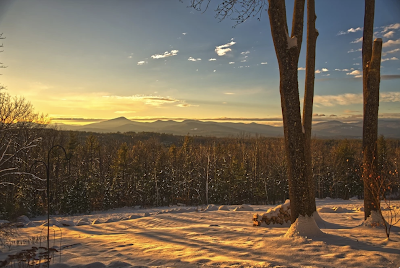
My backyard - Solar panels would fill the hillside below the mountains


It was gratifying to hear how many people describe how beautiful the views are from Christian Hill — how when traveling north or south through Lovell, they choose to drive our road instead of Route 5, the main north/south thoroughfare through town. It’s a slower, less-direct path but more scenic and relaxing. That path would also would take one over Hatch’s Hill, which is part of the old “‘Scoggin Trail,” an ancient north/south path used for centuries by the Pequawket Indians to go from the Saco River Valley to the Androscoggin River Valley. The views from Hatch’s Hill have not been tended and are being gradually obscured by vegetative growth.


Looking at 180 acres of hillside covered by 170,000 solar panels would render the viewer an entirely different feeling than what it would replace — hillsides of forest that change with the seasons and with the time of day. Walden Renewables tries hard to balance that with hollow verbiage about forestalling global warming and providing clean energy, but it doesn’t wash. Aside from the visual ugliness there are other issues. An acquaintance recently sent this along:


The main problem with solar arrays is the chemicals needed to process silicate into the silicon used in the panels. To make pure enough silicon requires processing it with hydrochloric acid, sulfuric acid, nitric acid, hydrogen fluoride, trichloroethane, and acetone. In addition, they also need gallium, arsenide, copper-indium-gallium-diselenide, and cadmium-telluride, which also are highly toxic. Silicon dust is a hazard to the workers, and the panels cannot be recycled.


Posting the above paragraph in a web search produced several links. Typical was a link called: “Debunking the debunkers/Andrew Tobias” in which Tobias contended that some of the article from which the paragraph came contained errors. The errors he cited, however, were minor and he was forced to let most of the article’s claims stand on their own merit.
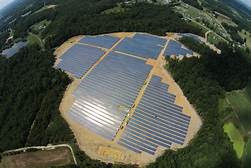


All 170,000 solar panels Walden Renewables would erect here would be made in China, America’s biggest enemy. Although Walden promises to fund the decommissioning of their panels after they’re obsolete in 20-30 years, what happens of they go bankrupt in the meantime? Would the landowners who leased their land to Walden be stuck with them? Would the Town of Lovell be? Would China take them back? Fat chance. According to an article in Discover Magazine: “It often costs companies more to recycle a solar panel than to produce a solar panel.”


Particularly grating on me is that I’m involuntarily paying for the solar panels that Walden would install to destroy my view. The solar industry is heavily subsidized by state and federal tax credits, tax exemptions, sales tax exemptions, rebates, and grants. Do you pay taxes? Then your money goes into these things whether you like it or not. If it didn’t, Walden Renewables wouldn’t exist. Without taxpayer subsidies, solar arrays like this wouldn’t be viable business ventures.


People testifying at the Lovell Planning Board meeting overwhelmingly said they were blindsided by this project. Many, including me, were angry about that. When a moratorium was called for to give citizens more time to consider the 600-page application however, the board voted 3-2 against recommending the moratorium — not on its merits, but because the board lacks legal counsel at this time. Citizens in opposition to the siting of the solar project are afraid the Planning Board will vote to accept the 600-page application and thereby commit itself to a specific timetable for acting on it.


Lovell citizens felt blindsided by this huge, Walden Renewables application and declared they need much more time to consider it. Commensurately, Lovell’s Planning Board seemed taken aback by the vociferous citizen reaction. Now we'll have to see what they do at their next meeting January 5th.


Wednesday, November 24, 2021

WALDEN RENEWABLES SNEAKS INTO LOVELL


Flyer going around town

Solar energy is disturbing the peace here on Christian Hill in Lovell, Maine. Residents are angry because they didn’t know anything about a huge, multi-million-dollar, 171 acre, solar-panel project that will be visible from our hill. What really ticks them off is that, by the time they found out about it, it was already too late to do anything about it. Locals have been calling me and knocking on my door wanting to know what to do. According to what I have been able to learn so far, not much, because Lovell doesn’t have an ordinance to regulate these things and I suspect the solar company knew that.


I'll be seeing solar panels just to the left of the birdhouse

I knew nothing either until about two weeks ago. Even though the site abuts my property, I was never notified. To say that annoys me is understatement. A friend and I purchased 30 acres of overgrown former apple orchard enclosed by stone walls on Christian Hill over forty years ago. The land slopes down from the road, which is a big disadvantage in every way but one: there’s a beautiful view westward toward the White Mountain National Forest in neighboring New Hampshire. 


From my back porch
Solar panels would replace pines & hardwoods on the bottom


After splitting the thirty acres down the middle, my wife and I built a home on our half and moved into it in 1988. For the next several years, I personally reopened the view by cutting down enough trees for eight cords of wood every summer. I split it by hand and burned it to keep us warm each winter until I had cleared my half of the overgrown apple orchard.


Solar Panels would be under the cloud in the center

I had stabilized the disturbed soil around our new house with a conservation mix but our gravel driveway remained a challenge. Thunderstorms opened gullies every summer until we figured out where to install ditches and culverts. Then I hired an excavator to remove the stumps left in the former orchard and stabilized the disturbed soil with more conservation mix. I get it bush-hogged each year now to maintain the field and preserve our vista. It’s been a lot of work and expense, but the scenery always made it worthwhile.


My granddaughters Solar panels would dominate the view to the left of the birch tree


Lovell’s proposed solar project, however, will ruin that view. If it goes through as proposed, about half our panorama will be of hundreds black solar panels. My forty years of hard work has increased the value of our property, but whatever it’s worth will be considerably diminished if our view is spoiled by acre after acre of ugly black solar panels.


The solar company that would destroy my vista calls itself “Walden Renewables,” probably to conjure bucolic images a la Henry David Thoreau. However, row after parallel row of fifteen-foot-high, black solar solar panels is anything but bucolic. The 600-page Walden Renewables application to the Town of Lovell suggests we visualize sheep grazing beneath their black monstrosities and promises to decommission them after thirty years. Then, they say, the land would be open pasture. But if I live that long, I’ll be a hundred years old. Maybe I’ll get to watch them finally disassemble the monstrous things from a rocking chair on my back porch.


This view would be ruined

These huge collections of panels not only look ugly, but their transformers are noisy. It’s not a loud noise, but it can be annoying because it’s a “Pure Tone.” According to Michael Bahtiarian, a sound engineer at Acentech: “In my opinion, when a person is bothered by sound, it is more likely the presence of a Pure Tone that is bothering them rather than just the sound level. At the wrong frequencies, a Pure Tone can be a highly annoying sound” It’s about as loud as a vacuum cleaner.


Solar panels would replace the snow-covered pines

Lest you think this is just a local problem we’re dealing with, check out a November 2nd New York Times account: “Approximately 0.5 percent of U.S. land would need to be covered with solar panels to achieve the decarbonization goals proposed by the Biden administration in April, according to a study by the Energy Department." That’s 190,000 square miles, folks, and they’re not going to be built in cities. Expect to see them just about everywhere you look when you go for that nice, peaceful ride in the country.


Solar panels would replace the pines in the mist

Walden Renewables started quietly buying up leases in Lovell last February, but didn’t submit their application until October after all the summer people went home. Sneaky, huh? From what I can gather, the project will be visible from Kezar Lake where most of them own property. They have deeper pockets than us locals and have always helped enormously during previous fights against a nuclear-waste dump, a series of GWEN towers the Pentagon proposed to help generals communicate after a nuclear attack had killed the rest of us, and several other battles against huge projects by outsiders.


The area lit up would be all solar panels

Lovell’s Planning Board will consider the Walden Renewables application at its regular meeting Wednesday, December 1st. It will be at the Lovell Town Hall because they expect a lot of people.


 I hope they’re right.


Sunday, June 14, 2020

POINTLESS CMP CORRIDOR REFERENDUM


“The End Is Near!” was a recurring theme in the old Mad Magazine which ceased publishing last summer after a 67-year run. As a kid I read it religiously and was surprised it stayed around that long as I hadn’t seen a copy for decades. Turning pages of each new edition in the fifties and sixties, I’d see caricature variations of a gray-bearded man in a robe carrying a sign warning of impending apocalypse. MAD satirized everything; it was totally unserious and that appealed to me.


Some of that unseriousness is still in me, especially when hearing leftist Democrats preach variations of their “The End Is Near” rhetoric. They’ve long sermonized about doom from “global warming” or “climate change” during which the polar ice caps and alpine glaciers will ostensibly melt, flood the oceans, and kill millions unless we “Repent Now!” by abandoning fossil fuels, buying carbon credits, and totally switching over to windmills and solar panels.


Used to be they included hydroelectricity in their “clean energy” pantheon, but it seems to have fallen from grace. Nearly everywhere I’m seeing “NO CMP CORRIDOR” lawn signs after a referendum campaign put the question on Maine’s November ballot. Central Maine Power has plans to construct a powerline in western Maine to carry electricity from Hydro Quebec to Massachusetts.


Twice I’ve questioned champions of this movement about their reasons for opposing the line. Their biggest arguments were that, one: it would be unsightly, and two: it would cut trees along its route from the Canadian border to southern Maine. “What’s wrong with that?” I asked. “Well, trees absorb carbon dioxide and help prevent climate change,” was their answer.


I should disclose here that I’m not a believer in human-caused climate change and have written numerous columns over the years refuting it. When discussing the corridor issue, however, I didn’t proselytize; I just tried to understand the opposition. I’ve read the literature on their web sites like: https://www.nocmpcorridor.com and others and I’m still confused. The New England region needs more electricity and no combinations of solar panels and windmills can produce enough no matter how heavily they’re subsidized.


But this column isn’t about the deficiencies of “renewable energy.” It’s about trying to make sense of leftist/environmentalist opposition to hydroelectricity from Quebec. If they’re so worried about carbon emissions and global warming, what sense does it make to oppose hydroelectricity which doesn’t emit carbon? Yes, some trees would be cut down in a corridor for a new powerline, but other green things will grow there. Look at older power line corridors all over the landscape. There’s plenty of growth under the lines and it absorbs carbon too. 

Go to nocmpcorridor.com and look at the arguments; they’re the weakest I’ve ever seen in a political campaign:


“A 53 mile corridor the width of the New Jersey Turnpike would cut through western Maine, crossing some of the country's last native brook trout habitat, fragile wetlands, deer yards and ruining pristine scenic views,” it claims. Trout streams are not endangered. Neither are deer yards, or fragile wetlands. I concede that views would be compromised, but that’s it.


“Countless jobs in the biomass industry and related forest products industries would be put in jeopardy” the site claims. Really? How?

“Tourism is the number one industry in Maine, and this corridor will jeopardize those jobs,” it says. Really? Seasonal homes need electricity. So do campgrounds, hotels, restaurants, and just about all other tourist infrastructure. How, exactly, will a power line jeopardize those jobs? I can’t imagine.


The only plausible reason leftist/environmentalist groups oppose the CMP corridor is hinted at: “This corridor would jeopardize Maine’s renewable energy sector, which could lose hundreds of millions of dollars over the next fifteen years as a direct result of this project.” I guess they’re afraid that lots of clean electricity coming down from Canada would negate any need for additional “renewable sources” and, hence, the need for further taxpayer subsidies of their cherished wind and solar projects.


Wind and solar industries can’t survive without taxpayer subsidies because they cost more than they deliver and don’t produce energy on calm, cloudy days. To this writer, it looks like the NO CMP CORRIDOR movement is mostly afraid of losing its continued access to the government teat.


The whole campaign is tailor-made for a MAD Magazine spoof. Too bad it’s not around anymore.

ADDENDUM: Maine’s CMP Corridor was proposed after the “Northern Pass” project was rejected in neighboring New Hampshire.