Showing posts with label New England. Show all posts

Tuesday, August 18, 2020

TO SIGN OR NOT TO SIGN


A US Census lady knocked on my door over the weekend and asked very few questions compared to what were asked during the 2010 or 2000 census. After recording names, sexes, and birthdates of people who lived at my address on April 1st, she came to the inevitable race question which went something like: did I consider myself Hispanic? I told her I’m human; so is my wife, and that’s all she needed to know. With that she said she was all done and got up to leave.


Surprised, I asked her what the federal government would do with data about race if I had identified myself as belonging to one of its categories. She said would have had more questions if I had identified as “white.” She would have asked about ethnicities like Irish or Italian, but since I declined to racially categorize myself or my wife, she stopped. There were no questions about religion, occupation, or citizenship status — the kind of data useful to historians studying trends. Perhaps she knew I was a retired teacher, but wasn’t aware that I still work. We live in the same town and I know her and her family.


Government at all levels is obsessed with discriminating between people based on skin color or ethnicity, and has been for as long as I can remember. Decades ago I stopped cooperating. When encountering ubiquitous race questions on official forms, my habit is to draw in a box, label it “human” and put a check it. While distributing state testing forms in my public school classroom, I suggested to students that they could do the same. Many did.


Obsession with race is getting worse. At the University of Southern Maine in Portland — a state institution — president Glenn Cummings recently asked all students and faculty to sign a “Black Lives Matter Statement and Antiracism Pledge.” He intends to publish a list of everyone who signs it, and that, by process of elimination, would also become a list of those who did not sign it. Would they then be subject to sanctions or harassment?


What about students and faculty who, while recognizing historical oppression of blacks in America, disagree with BLM’s anti-capitalism or its inherent Marxism? How about those who object to a pledge by BLM’s Greater New York president Hawk Newsome that: “If this country doesn't give us what we want, then we will burn down this system and replace it”? Or how about those who disagree with Chicago BLM organizer Ariel Atkins who said BLM rioters looting stores were justified because: “That is reparations. Anything they wanted to take, they can take it because these businesses have insurance.”


The University of Southern Maine pledge states that:


We stand in solidarity with those who are working for justice and change. And we invite you to join us in pledging to be a practicing antiracist at the University of Southern Maine and in all aspects of your life. We believe, as Ibram Kendi writes, that "the only way to undo racism is to constantly identify it and describe it — and then dismantle it.”


Never having heard of Ibram Kendi, I did searches on him. His latest book is: How To Be An Antiracist. About it, Christopher Caldwell contends in National Review:


Anti-racists assume that the American system of politics, economics, and policing has been corrupted by racial prejudice, that such prejudice explains the entire difference in socioeconomic status between blacks and others, that the status quo must be fought and beaten, and that anyone not actively engaged in this system-changing work is a collaborator with racism, and therefore himself a legitimate target for attack.


This is dangerous rhetoric. It assumes that “systemic racism” is a real thing — that if you’re white, you were born with “white privilege,” as well as inherent racism against so-called “people of color.” If you don’t sign pledges like the one USM President Glenn Cummings urges you to sign, if you don’t kneel during the national anthem, if you don’t constantly proclaim that you’re not racist, you might as well proclaim that you are. The USM “community” will no doubt see you as such.


USM is a state institution. It’s supported by our tax dollars and it shouldn’t be pressuring its students or faculty to support political positions, much less radical-left ideologies like those espoused by Black Lives Matter. Along with almost all levels of government, USM is obsessed by race. We would all do better to insist there is only one race — the human race — and no subsidiaries exist.


Monday, August 03, 2020

PORTLAND CITY HALL HOMELESS ENCAMPMENT


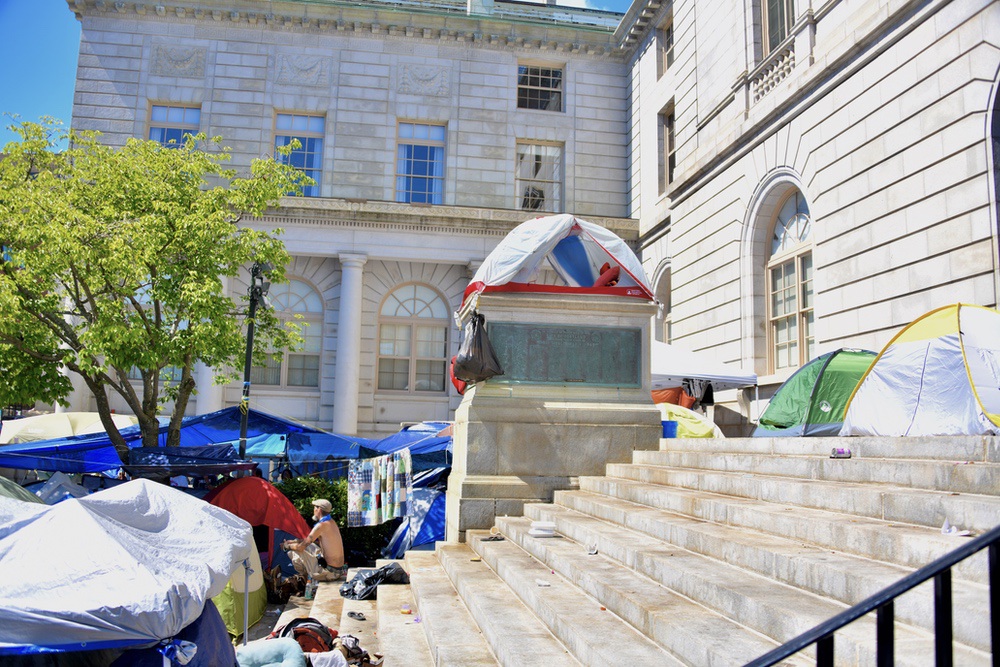
“I have nine children with nine different women,” said Richard Cox, 56, who also said he is a former Army Ranger and has been homeless for a year. He, along with Aaron Porter, 24, were assigned to me as trained press liaisons for the homeless encampment at Portland City Hall on Congress Street. Aaron told me he has been homeless for eight years but both men preferred to call themselves “unhoused.”


Press liasons Richard Cox and Aaron Porter


They were attached to me last Friday after I took some pictures near the medical tent and asked questions of the volunteers there. One got on a walkie-talkie and pretty soon Richard and Aaron showed up. We went around the corner on a side street so my digital audio device didn’t pick up traffic noise or screaming obscenities from “residents” like the two women near us were delivering with incredibly-loud voices. 


Gray stains on pavement are dried urine


The “unhoused” encampment has grown on the steps of Portland City Hall and on the sidewalks in front of and beside the impressive stone edifice for almost two weeks. It would be more accurate to describe the building as a formerly-impressive edifice as it’s now covered with stains of dried urine, tents, trash,  sleeping bags, canopies, and people sleeping or walking around. How much more the encampment grows may be determined by a Portland City Council meeting scheduled for Monday, August 3rd.


Aaron and Richard told me no one is working in the building since Covid and are instead working from home. However, the Portland Press Herald reported that City Hall closed for business the previous Monday because staff felt unsafe. Walking around the encampment, I was reminded of what's happening at the other Portland on the west coast and in Seattle where leftists took over whole city blocks.


A large, prominent, professionally-printed sign on the sidewalk declared: “Our Demands,” which included: “DEFUND THE POLICE” and “EXTEND EVICTION FREEZE.” Another sign said: “HOMELESS LIVES MATTER.” That called to mind the Black Lives Matters protests there few weeks ago accompanied by violence and looting. Protesters included organizers like African refugees Hamdia Ahmed and Abdul Ali. Later, someone named Abdikareem Hasan was arrested for firing several shots into the nearby Portland Police Station parking garage.


Abdikareem Hassan


Leaving Richard and Aaron and walking carefully up the steps of City Hall, I squeezed between tents and sleeping bags, some with crashed-out people in them. There was dried urine all the way to the top and I couldn’t avoid stepping in it. I pitied people in tents on the lower steps and on the sidewalk as the urine would, of course, flow down to them, especially when it rained. I was glad not to see, or step in, any excrement, however.


Urine stains on City Hall steps


In one kiosk, I saw a list of people to whom donated tents, sleeping bags, soap, XL women’s diapers, kids’ clothes, and many other donated items had been given. There were written directions conspicuously posted explaining when to administer Narcan for those who overdose. 

“Housed” people were arriving regularly to drop off items that were requested on still another list. Everything visible, except for the people, was donated from the outside. This was clearly kept going by others who wanted political visibility.


Press liaisons Richard and Aaron wore walkie-talkies on their belts and were periodically called to quell disturbances. A Paddy Wagon with blue lights flashing on the next block took people to the police station or to the Cumberland County Jail where I had been volunteering for four years until the pandemic closed it to employees and inmates only.


Preble Street Resource Center


Also closed down by government overreaction to the virus was the nearby Preble Street Resource Center. It had provided all the services to the homeless now being delivered at the City Hall encampment and more. That seems a foolish decision considering that those camping at City Hall and in Deering Oaks Park aren’t socially distancing and few wear masks. There were also toilets at Preble Street. Paradoxically, it seems the “unhoused” at the encampment don’t have to live in donated tents because city officials have said homeless shelters at Oxford Street and at the Portland Expo are operating at only half capacity.


Portland Police Chief Frank Clark reported that shots were fired at the encampment on Saturday. The whole thing seems a political stunt to this writer and US News said it's organized by something called the “Maine People’s Housing Coalition,” I did several searches for it and only came up with a Facebook page. Links from there led me to national, leftist sites with LGBT, socialist, and communist links. The Portland Press Herald, however, has not dug into the “Maine People’s Housing Coalition” or its affiliates.


Is Portland, Maine being plagued by the same leftist forces now ruining the other Portland on the west coast? It would seem so.


Wednesday, March 07, 2018

Fickle Flirt


Portland Harbor 2017
Spring has teased for weeks now, but New England knows she’s a flirt and not always a pretty one. Snowbanks melt back along streets in Portland to show us accumulated trash the careless have dropped or thrown from car windows all winter. With it are thawing remains of pigeons and seagulls. Little is picked up because we know more snow will bury it again and soon.

My granddaughters in Lovell

Along country roads the melt exposes empty beer cans but thankfully not many. Other detritus is mostly leaves and branches — the benign debris of Nature. Turkey buzzards back from southern climes appear overhead scouting remains of forest animals too old and weak to have survived winter. During seasonal transitions we look forward and back. New England poet Robert Frost reflected on this in A Patch of Old Snow:

There’s a patch of old snow in a corner
That I should have guessed
Was a blow-away paper
The rain had brought to rest.

It is speckled with grime as if
Small print overspread it,
The news of a day I’ve forgotten — 
If I ever read it.

Few poets appeal to me but Frost always has, and he knew the tease of March and April. Reading him I see it, smell it, feel it.

Frost in New Hampshire

Warm breezes over Portland Harbor carry a stronger scent of salt water. The sea was whipped up last weekend by a strong storm to our south and helped a full moon, making high tide very high indeed. Wind whipped the white salt spray from tops of waves, but Boston and Cape Cod absorbed most of the fury.


Next to Portland Harbor a mountain of snow melts slowly. Front-end loaders on city streets filled trucks that dumped load after load beside it as bulldozers pushed snow up ever higher up its side. Like the dirty snowbanks that comprise it, no white is visible. It’s a pile of frozen liquid covered with sand that doesn’t melt completely until the end of May sometime.

My back yard

After the flirt of our fickle New England spring comes the snub. By the time you’re reading this another storm will have blanketed everything once again. Then spring will resume her flirting only to spurn us again before April arrives. But our April spring isn’t steadfast either. Frost tells of that in the third stanza of Two Tramps in Mudtime:

The sun was warm but the wind was chill.
You know how it is with an April day
When the sun is out and the wind is still,
You're one month on in the middle of May.
But if you so much as dare to speak,
A cloud comes over the sunlit arch,
A wind comes off a frozen peak,
And you're two months back in the middle of March.


It’s not just ominous buzzards. Other, more agreeable birds appear too. Near the sea in South Portland I’ll see cardinals, but rarely do I see them in the mountains near Lovell.


Out my office window to NH

Frost the poet spent decades in New Hampshire, the mountains of which I see out my office window in western Maine. He describes another spring songbird in the fourth stanza:

A bluebird comes tenderly up to alight
And turns to the wind to unruffle a plume,
His song so pitched as not to excite
A single flower as yet to bloom.
It is snowing a flake; and he half knew
Winter was only playing possum.
Except in color he isn't blue,
But he wouldn't advise a thing to blossom.


March brings New Englanders together in town meetings as sap buckets appear on old maple trees. Mud forms atop frozen ground after the sun is high but freezes again at night — over and over before finally drying firm again. Mud doesn’t impede life in paved-over cities but it brings many things to a halt in the countryside. Roads are posted against heavy trucks. Loggers and builders wait for mud to dry, but most of us savor warm spring breezes. Frost wrote about those in To the Thawing Wind:


Come with rain, O loud Southwester! 
Bring the singer, bring the nester; 
Give the buried flower a dream; 
Make the settled snow-bank steam; 
Find the brown beneath the white; 
But whate’er you do to-night, 
Bathe my window, make it flow, 
Melt it as the ice will go; 
Melt the glass and leave the sticks 
Like a hermit’s crucifix; 
Burst into my narrow stall; 
Swing the picture on the wall; 
Run the rattling pages o’er; 
Scatter poems on the floor; 
Turn the poet out of door.

When our New England spring finally exposes the brown earth beneath, my wife is turned out with her boots on to scratch it and coax her buried flowers upward.